Virginia Wasserberg is a lifelong Republican, a deeply conservative home-schooling mom from Southeast Virginia.
Once a month, she logs onto Zoom to join an unlikely crew: there's a community organizer from Austin, Texas; a grandmother from rural Missouri; and an environmental justice activist from Port Arthur, Texas.
Wasserberg and her Zoom companions are members of Higher Ground, a national network of flood survivors. On paper, they don't have much in common. They span the income spectrum from working class to relatively affluent. They are African-American, white and Latinx; Democrats and Republicans; conservatives, moderates, and progressives. But they share one important experience: they are all dealing with floods in their homes and neighborhoods.
As the planet warms, those floods are becoming more severe. Stronger, wetter storms overflow the banks of Midwestern rivers, while hurricanes and sea-level rise inundate coastal communities. Antiquated infrastructure and short-sighted building practices make the problem worse. But as the waters are rising, so are flood survivors. Higher Ground, a project of the Florida-based nonprofit Anthropocene Alliance, now has 70 chapters in 22 states, plus Puerto Rico.
Wasserberg's experience is typical of the group's members. "On October 7, 2016, I couldn't have cared less about climate change," she said. "On October 8, a disaster woke me up." That disaster was a massive storm surge from Hurricane Matthew, which flooded her Virginia Beach home. "As soon as we got back in the house, I started looking around and saying, 'How did this happen and how can we prevent it from happening again?'" she said. That inquiry led Wasserberg to a new understanding of the science—and the politics--behind flooding and climate change.
Wasserberg got involved in her local civic league, then started organizing her neighbors through a group called Stop the Flooding Now. The group's Facebook site was spotted by Harriet Festing, director of the Anthropocene Alliance, who reached out. Soon, Wasserberg was connecting with others in similar straits. "I discovered that there were other people, not just in my community but throughout my country, who had the same problems I was having," Wasserberg said.
She met other flood survivors, including Dr. Gloria Horning, who is battling a dangerous new development in her flood-prone neighborhood in Pensacola, Florida. The group also includes Frances Acuña, whose Austin neighborhood experienced several "100-year" floods in the span of a few years, and David Southgate, whose neighbors in Ponce Playa, Puerto Rico, face possible displacement because of coastal erosion and flooding from climate-driven storms.
The first priority for Higher Ground members is to educate themselves—and others—on the root causes of flooding. To that end, Festing connects local groups with volunteer scientists from the Thriving Earth Exchange (TEX), a project of the American Geophysical Union.
Wasserberg was matched with Dr. Michelle Covi, a coastal resources expert at Old Dominion University. Covi linked her scientific explanations to real-life impacts: "She'd explain how what we are seeing on a graph translates to the water that's in my front yard," said Wasserberg. "It expanded my understanding, unlike anything ever could."
Linking climate change science to real world impacts
That pragmatic approach—linking climate science to what's happening in our front yards—has helped Wasserberg talk to her fellow conservatives, as well. Early on, a Higher Ground member from the Midwest counseled Wasserberg to lead with the what, rather than the why: "Just to get in the conversation, you start with 'something is happening,'" she said. "The main thing is to keep focused on the flooding. Once people start discussing the what, it's completely natural to end up on the why. That's how it's worked for me."
Dr. Horning agrees: "In Florida, climate change is a dirty word," she said. "Our governor doesn't believe in it; our senators don't believe in it; lots of Republicans in the community don't believe in it. But when you show them pictures and say, 'this happened, and this happened,' they say, 'well, maybe she's got a point.'"
In addition to illuminating challenges, Higher Ground members share solutions. They learn about what works from one another, and through seminars and trainings with experts. "We've learned about rain gardens, bioswales and other green infrastructure," said David Southgate. They also get schooled on the politics of flooding: "We've learned how big money influences the creation of flood maps that allow developers to build in areas where they shouldn't be building," Southgate said.
Practical knowledge and political savvy make Higher Ground members effective advocates. "We are not just complaining," said Frances Acuña, "we are offering choices and recommendations and offering to build a working relationship."
And Higher Ground members "train it forward," passing on what they've learned to others in their communities. "I've learned a lot about how to speak to your representative or your senator," said Acuña, "so now I'm doing a training for the community to teach back what I've learned, because it's important."
Solutions to flooding
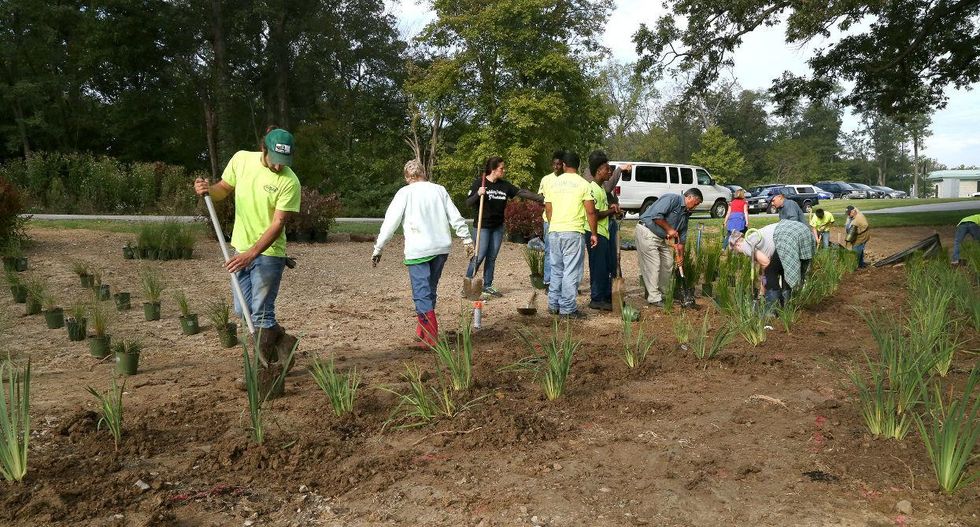
Students and landscapers work digging and planting in a bioswale area. (Credit: Lewis and Clark Community College/flickr)
Higher Ground's approach is getting results. Wasserberg's work in Virginia Beach sparked new building regulations; major capital projects to mitigate flooding—including tidal gates—are also in the works. Frances Acuña helped win a citywide flood-control resolution, and she now advises local officials on green infrastructure and disaster response. The community group David Southgate volunteers with, Un Nuevo Amanecer, persuaded the Army Corps of Engineers to launch a study that will guide climate adaptation in Ponce Playa.
Other Higher Ground members have successfully halted developments in flood-prone areas, instituted green infrastructure programs, promoted cleanups at toxic waste sites in areas that flood, and organized home buyouts. Recently, a member group called Rosewood Strong in Socastee, South Carolina, secured $13 million in federal funding to buy out 60 repeatedly flooded homes and use the land for green infrastructure.
But you could say that the group's greatest achievement lies in those monthly Zoom calls. Today, Americans have sorted ourselves into communities defined by geography, demography, ideology— and opportunities to communicate across those divides are exceedingly rare. But the shared trauma of flooding offers an opening.
"Floodwaters don't recognize geographical boundaries, political boundaries, or racial boundaries," said Wasserberg. "That was the catalyst for me to join with other people who had different perspectives, politically speaking. They had the same experience I had; they had water in their homes, just like me. We all found that common ground."
The circle of trust
We live in a society of weaponized information, where media outlets at opposing ends of the political spectrum no longer share a basic perception of reality. It's an atmosphere of metastasizing mistrust and contempt that threatens the very foundation of democracy. And yet: here is a diverse group of Americans, sharing information and making common cause. Like many conservatives, Wasserberg does not trust the mainstream media. But she does put faith in the information she gets from her fellow flood survivors and affiliated experts. "It's almost like a trust circle," she said.
Of course, Higher Ground is not an island; the bitter politics of this moment are not absent here. When partisan passions reached a fever pitch around the 2020 elections, Wasserberg stepped away from activism for a few months, fearing that her conservatism would make her a target. And she declines to sign on to Higher Ground initiatives that don't align with her politics. But that does not affect her relationships with other members of the group. "There's room for us to be who we are," she said.
The group's winning formula does not guarantee success. Indeed, Higher Ground members are often locked in struggle with entrenched local power structures. Dr. Steven Emerman, a TEX volunteer who advises several local flood-survivor groups, observed that facts are often no match for ideology: "I've never seen a case where you take a city council member who's totally pro development, and you show him or her the facts about flooding, and they just change their mind." Victories are rarely permanent: as long as there is money to be made—or votes to be gained—by building in flood-prone areas, the flooding will continue.
What is needed is a sea change in our politics. That will require new understanding of flood risks, and of how those are made worse by a changing climate. That, in turn, requires communication across the gaping divides in American society. We need a wider "circle of trust."
Like other members of Higher Ground, Virginia Wasserberg is doing her part. Recently, she launched an initiative to put climate change and sea-level rise on the platforms of Republican candidates, and to hold them accountable once they are in office.
"Republicans like myself who care about the environment need to stand up and do something about it," she said. "We can't just sit on the sidelines and let this be a political issue. It's a human issue."
Laurie Mazur is the editor of the Island Press Urban Resilience Project, which is supported by The Kresge Foundation and The JPB Foundation.
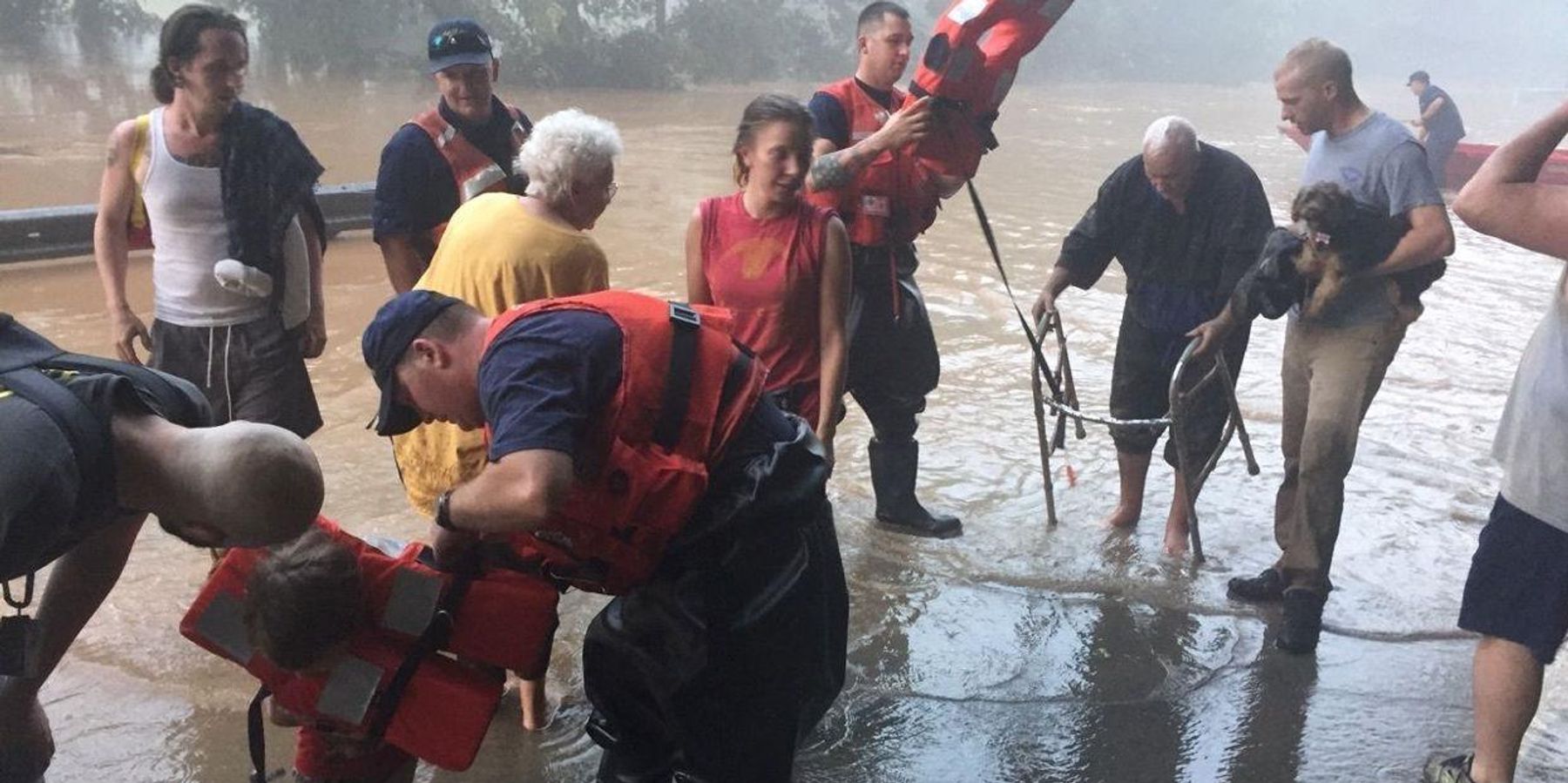
Banner photo credit: Coast Guard responds to flooding in West Virginia in 2016. (Credit: Coast Guard News/flickr)