Why do so many people distrust scientists? Just take a look at the characters that represent scientists in TV and movies.
Here they are, in three categories.
The Professors
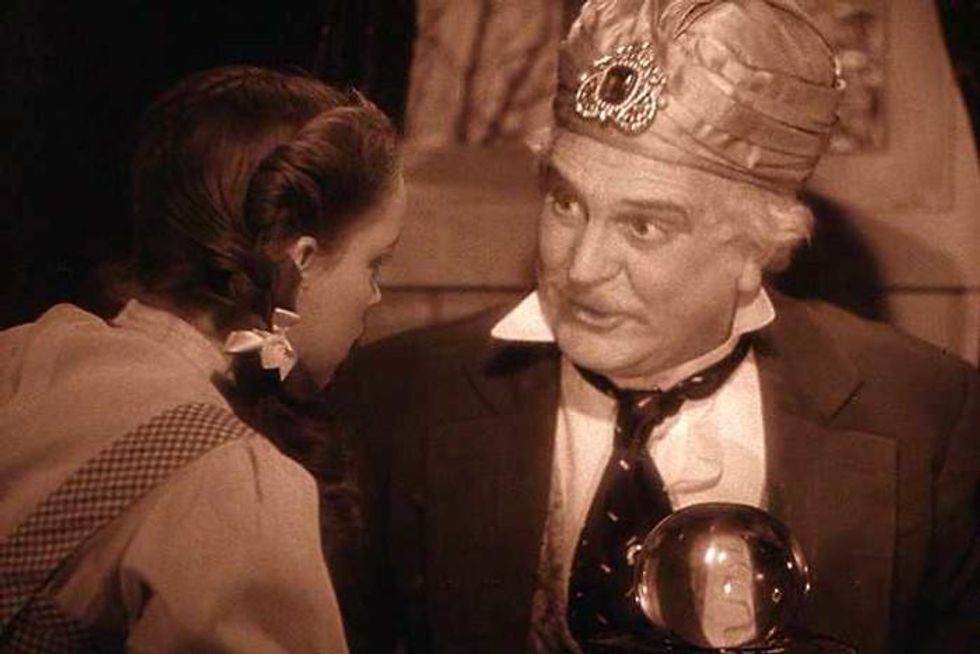
Professor Marvel (Frank Morgan) tells Dorothy that Auntie Em is ill.
During my four years at Boston University, I had what is probably the usual mix of good professors, lousy professors, and weird professors. But I can't think of any that were made-for-Hollywood.
Here are some that I must have missed.
The Professor (v1): There's nothing sadder than a humorless guy on a hit comedy show, except maybe for a humorless, nameless guy. The Gilligan's Island Professor is the standard bearer for scientific nerdiness. (Note: His name, used only once or twice in four years' worth of episodes, was Roy Hinkley.)
The Professor (v2): Before Felix the Cat became an iconic wall clock, he first appeared in silent cartoons as early as 1919. But in the late 1950's he starred in 260 animated shorts, often opposed by The Professor, a mustachioed villain obsessed with filching Felix's Magic Bag of Tricks.
Professor Frink: John I.Q. Nerdelbaum Frink, Jr. is a regular on The Simpsons. He is the inventor of the hamburger earmuffs.
Professor Irwin Corey: His popular 1950's nightclub act featured the "World's Foremost Authority" in a rumpled cap-and-gown, spouting high-minded gibberish not intended to be understood by anyone. The anti-Communist McCarthy blacklist silenced him until a late 1960's comeback made him a TV fixture. He performed until shortly before his death at age 102 in 2017.
Professor(s) Klump: Jerry Lewis played the 1963 version. Julius Kelp was a bucktoothed, nearsighted Nutty Professor named Julius Kelp whose magic potion turned him into suave lothario Buddy Love. Eddie Murphy revived the character in 1996 with his obese Nutty Professor Sherman Klump. Both are in turn loosely based on Robert Louis Stevenson's 1886 book, The Strange Case of Dr.Jekyll and Mr. Hyde.
Professor Marvel: Of course, the broken-down traveling con man from The Wizard of Oz was not really a professor at all. His alter ego, the Wizard, comes through at the end, though.The Doctors
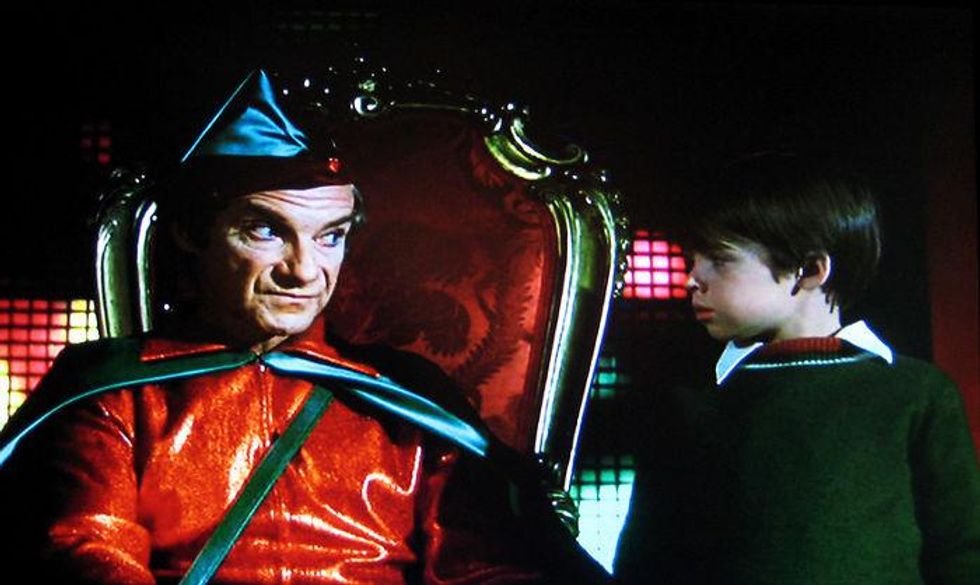
Dr. Zachary Smith, Lost in Space.
"Doctors" make up a second subset of oddball scientists. Dr. Strangelove, the hydrogen bomb loving ex-Nazi; Doc Brown, the time-traveling loon from the Back to the Future movies; and Austin Powers' inept foe Dr. Evil are no-brainers.
Mary Shelley gave literary birth to Herr Doctor Viktor Frankenstein in 1818, lest we think that this evil scientist thing is relatively new. In 1931, Colin Clive portrayed the quintessential evil scientist on the screen. Gene Wilder played his grandson for laughs in 1974's Young Frankenstein.
An obscure, personal fave: Singer/songwriter Tom Waits as the oh-so-unusual Doc Heller in 2004's Mystery Men.
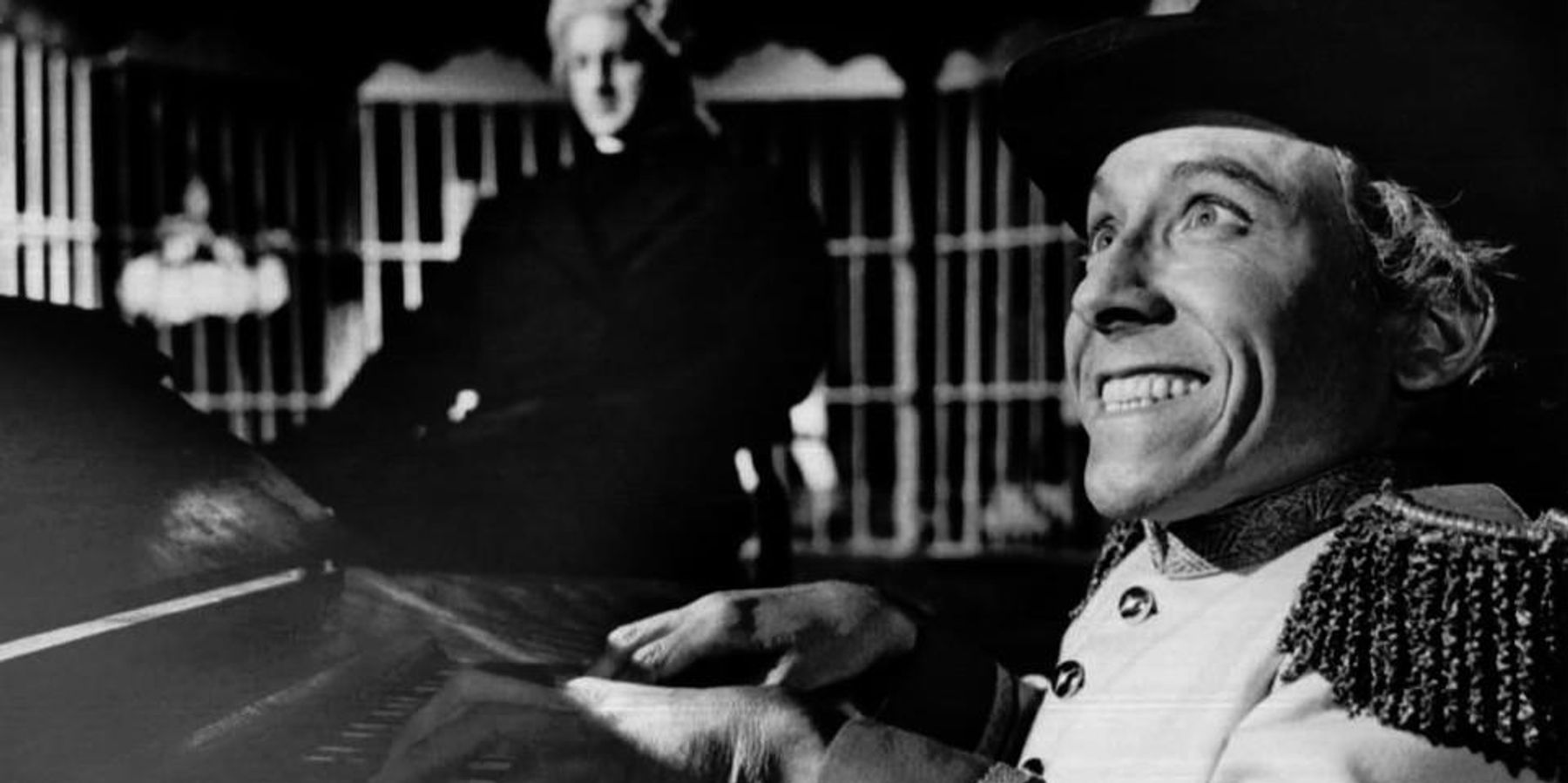
Dr. Loveless of Wild Wild West fame: Kenneth Branagh was purely evil in the 1999 movie, I'm partial to Michael Dunn, who played Loveless as an evil dwarf with a great sense of humor on the 1960's TV show.
Dr. Zachary Smith, the sniveling, treacherous stowaway from Lost in Space. In an overacting effort worthy of William Shatner, Jonathan Harris sneers and whines his way into our hearts.
Two more Doctors who aren't goofballs, but deserve mention are:
Dr. Research: Maybe they could have put a little research into finding a better name, but in the late 1950s, Bell Labs produced a remarkable series of science films. CBS aired them. In one, Dr. Research (played by a real-life UCLA English Literature professor, Frank Baxter) gives a spot-on projection of what fossil fuel burning would do to the earth.
Dr. Dolittle was played by Rex Harrison in the original 1967 film—both talking and singing to the animals. Eddie Murphy starred in the 1999 remake, which exceeded the original in veterinary toilet humor.
The Others
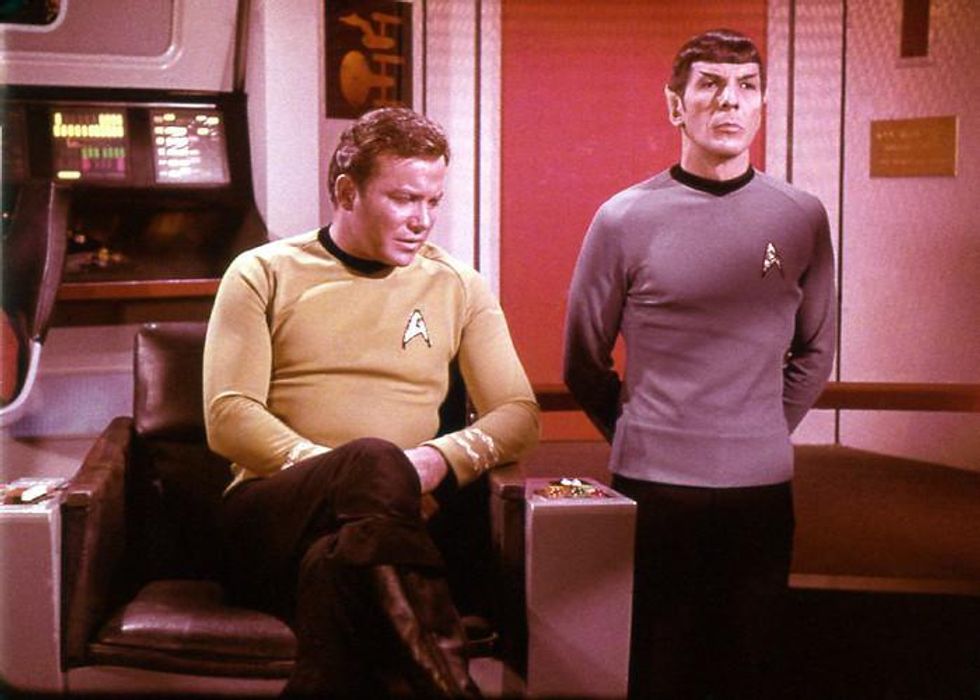
Kirk and Spock.
Spock: The ears are adorable, he's a sci-fi hero, and, to borrow a bit of timeworn racist condescension, he's a credit to the Vulcan race. You know, the Vulcan race whose sex drive allows them one compulsory fling every seven years. Some nerds might envy Spock for such frequency. But they'd embrace him as a nerd, if the embracing rules permit.
Josef Mengele: You've got to have a lot of evil on your scientist résumé to get hired by Hitler. Mengele was insane and sadistic. Until recently, I blamed him for the breeding of Labrador retrievers and standard poodles. But Gregory Peck's bone-chilling portrayal of him in The Boys from Brazil (1978) shows us perhaps the most horrible scientist ever. I bet they don't show this at the Future Scientists Club meetings.
The Big Bang Theory: The long-running CBS show just ended its 12-year run and has entered the lucrative syndication market. It features four young, accomplished scientists with the social skills of a nerd, a dork, a geek, and a dweeb, respectively.
Magnus Pyke: Who, you ask? Magnus was a British TV personality who often played scientists. He was a natural choice for the lab-coated dork who shouts "science!" in Thomas Dolby's biggest hit.
Dexter's Lab: A precocious boy scientist who fights another uber-scientist, Mandark. It was a seven-year hit on Cartoon Network.
The exception that proves the rule
Indiana Jones is badass, but not bad. How can a swashbuckling archaeologist who battles Nazis and other assorted badguys be a bad guy himself?
However, any truly good scientist would tell you that the exception-proves-the-rule stuff is a steaming pile of hooey.
Peter Dykstra is our weekend editor and columnist. Contact Peter at pdykstra@ehn.org or @pdykstra.
His views do not necessarily represent those of Environmental Health News, The Daily Climate, or publisher, Environmental Health Sciences.
Banner photo: Jim Shane (in background) and Michael Dunn as Dr. Loveless from the television program The Wild Wild West. (Credit: Wikimedia Commons)