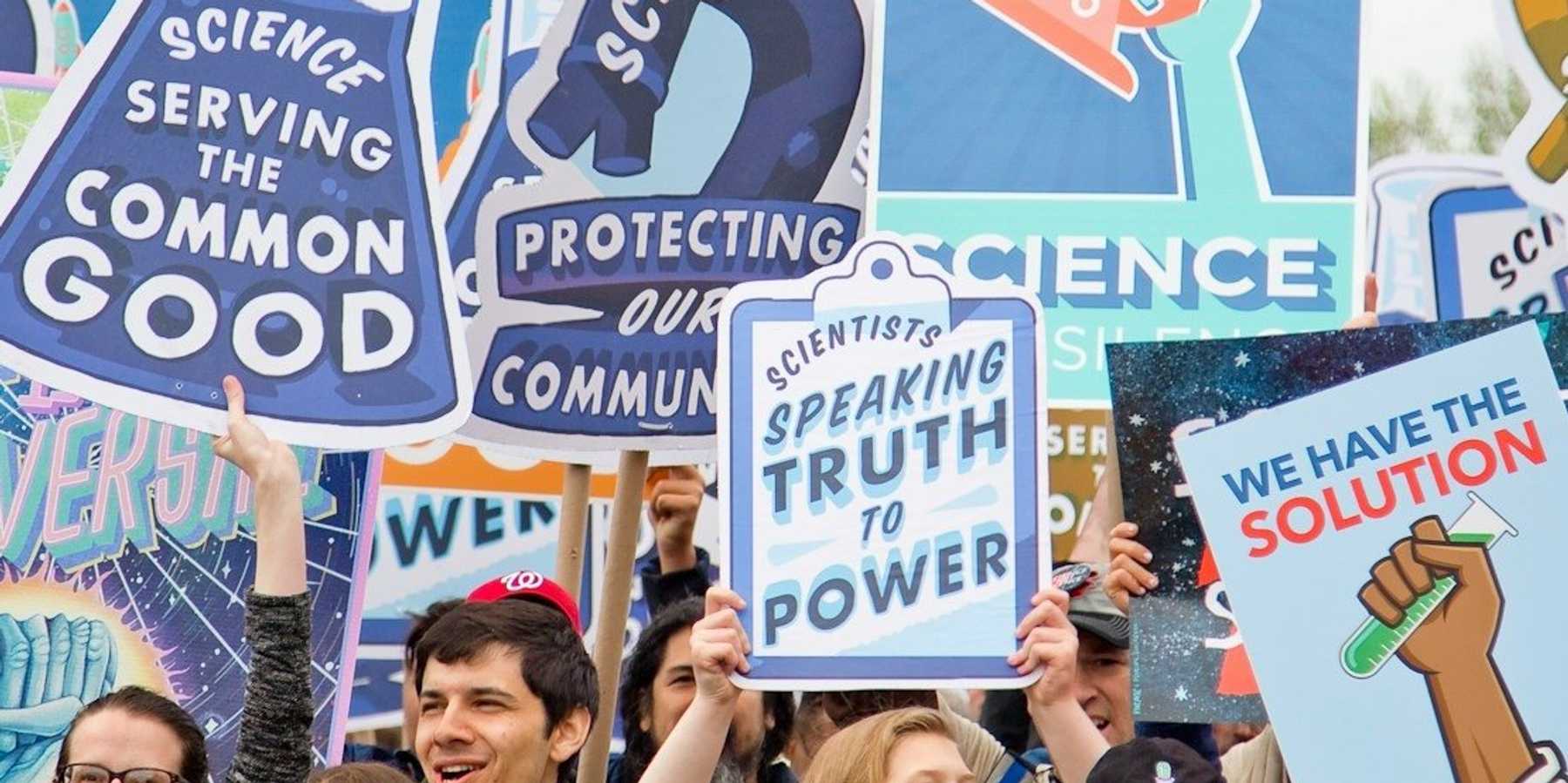
Smiling people with signs marching in support of science.

U.S. science policy drifts, recalling Soviet era

Political scientists warn that the Trump administration’s handling of climate science and environmental policy recalls the Soviet dismissal of scientific integrity and comes amid a rapid erosion of democratic norms.

Lois Parshley reports for Grist.


In short:

  • The administration has repeatedly weakened environmental regulations, from the Clean Water Act to the Endangered Species Act, while claiming emergencies that fast-track fossil fuel projects.
  • Politically connected companies, especially in oil and gas, benefit from tax breaks, regulatory rollbacks, and legal leverage, amplifying corporate influence over public policy.
  • The article links Stalin-era Soviet agriculture under Trofim Lysenko to the Trump administration’s climate and environmental policies, showing how both regimes subordinated science to ideology and political loyalty.

Key quote:

“The lack of constraints on the executive allow politically connected companies to either get around existing laws or to write laws in such a way that they’re toothless.”

— Timothy Frye, professor of post-Soviet politics, Columbia University

Why this matters:

Under the Trump administration, environmental rules designed to protect water, wildlife, and communities are being routinely rewritten or ignored, sometimes under the guise of an “emergency” that conveniently speeds up oil and gas projects. Federal agencies are challenging long-settled science on climate change and other environmental issues, with profound implications for human health. At the same time, companies with deep political ties are thriving, scoring tax breaks, looser regulations, and enjoying a legal playing field tilted in their favor. Frye notes that autocratic leaders often build their economies around natural resources because they are easier to control than other industries. Whether the U.S. will be able to recover its institutions, environmental protections, and its standing as a global scientific leader remains to be seen.

Read more:

Palm trees in front of tall buildings blowing in hurricane gales

The emerging danger of post-hurricane heat waves

With global warming making people increasingly dependent on air conditioning, power failures from hurricanes followed by heat waves are creating increasingly hazardous risks to health.
The Great Salt Lake on a blue sky day

The Great Salt Lake is dying and fixing it could cost billions

Two factors are driving the decline of the Great Salt Lake: water use and less precipitation due to climate change. Saving the lake may require 260 billion gallons of water.

A tropical location with palm trees and the sunset in the background
Credit: Hans/Unsplash+

Tropics take the brunt as hotter oceans drive large-scale humid heat waves: Study

As climate change intensifies, people around the world are learning firsthand how dangerous high temperatures can be, and prolonged heat becomes even more dangerous, and deadly, when paired with high humidity.

The facade of the White House on a sunny day

How the Trump administration’s climate math doesn’t add up

There's an old argument that protecting the environment hurts the economy. It's wrong for a lot of reasons.
power plant towers with smoke emitting from the top

Trump EPA proposes loosening restrictions on toxic coal ash disposal

Federal regulators have proposed a rule that would loosen restrictions on the storage of toxic waste that is created by burning coal to produce electricity, a move that critics say favors industry interests over public health.

Red and white tanker with "LNG" printed on the side.

Stung by Iran war, countries are turning against U.S. fossil fuels

As economies in Asia and Europe reel from the energy disruption, leaders make plans to permanently replace imported oil and gas with homegrown energy.
United States Environmental Protection Agency (EPA) sign at the headquarters building in Washington, DC.
Credit: marcnorman/BigStock Photo ID: 21123533

EPA sets ‘no surprises’ science policy, reassigns researchers

Staff expressed frustration with how the transfers are being handled and perceive them as yet another measure to traumatize the workforce.
From our Newsroom
Multiple Houston-area oil and gas facilities that have violated pollution laws are seeking permit renewals

Multiple Houston-area oil and gas facilities that have violated pollution laws are seeking permit renewals

One facility has emitted cancer-causing chemicals into waterways at levels up to 520% higher than legal limits.

Regulators are underestimating health impacts from air pollution: Study

Regulators are underestimating health impacts from air pollution: Study

"The reality is, we are not exposed to one chemical at a time.”

Pennsylvania governor Josh Shapiro speaks with the state flag and American flag behind him.

Two years into his term, has Gov. Shapiro kept his promises to regulate Pennsylvania’s fracking industry?

A new report assesses the administration’s progress and makes new recommendations

silhouette of people holding hands by a lake at sunset

An open letter from EPA staff to the American public

“We cannot stand by and allow this to happen. We need to hold this administration accountable.”

wildfire retardants being sprayed by plane

New evidence links heavy metal pollution with wildfire retardants

“The chemical black box” that blankets wildfire-impacted areas is increasingly under scrutiny.

Stay informed: sign up for The Daily Climate newsletter
Top news on climate impacts, solutions, politics, drivers. Delivered to your inbox week days.