Mental health has been on my mind lately, largely because EHN.org and The Allegheny Front just published a large series looking at the impacts of air, water and climate pollution on our mental health.
Turns out it's a vastly under-researched and under-reported topic. We know that air pollution affects the lungs. But such pollution also affects every bodily system, including the brain.
And then there's stress: Stress of coping with a changing climate, stress of living near fracking operations, stress of fighting for clean air and water, stress of wondering whether living in a particular house or neighborhood hurts the health of your kids.
All that has an impact on mental health, too.
Mental health & healthcare: An unlikely pairing
What sort of connection, I wondered, exists between our mental health and efforts to make healthcare more sustainable and healthy?
It's an unlikely pairing, I'll admit: I can't say, for instance, how efforts by my local hospital to reduce plastic affect my mental health.
But that kind of thinking on pollution and mental health has left a collective blind spot, our reporting team found. And I wondered if something similar existed on healthcare.
It’s common for people in fracked communities to experience "worry, anxiety, and depression about lifestyle, health, safety, and financial security," a literature review on fracking and mental health reported. “Entire communities can experience collective trauma as a result of the boom/bust cycle that often occurs when industries impinge on community life."
'Stress creates its own health impacts'
A lead author of a Pennsylvania fracking study relayed a story about a community member who suddenly understood, after fracking moved in, why sleep deprivation is used as a torture technique.
"That kind of stress creates its own health impacts," the researcher told our reporter. "When we document that someone has a headache, for example, is that because of a chemical exposure or because they haven't slept and their neighbors don't trust them anymore?"
So when I searched our databases for news stories about sustainability and either healthcare or mental health, I was pleasantly surprised to find nearly 33,000 stories in the last month.
More than one third – 22,000 – focused on healthcare and sustainability. About 10,500 focused on mental health.
Shared themes and concepts
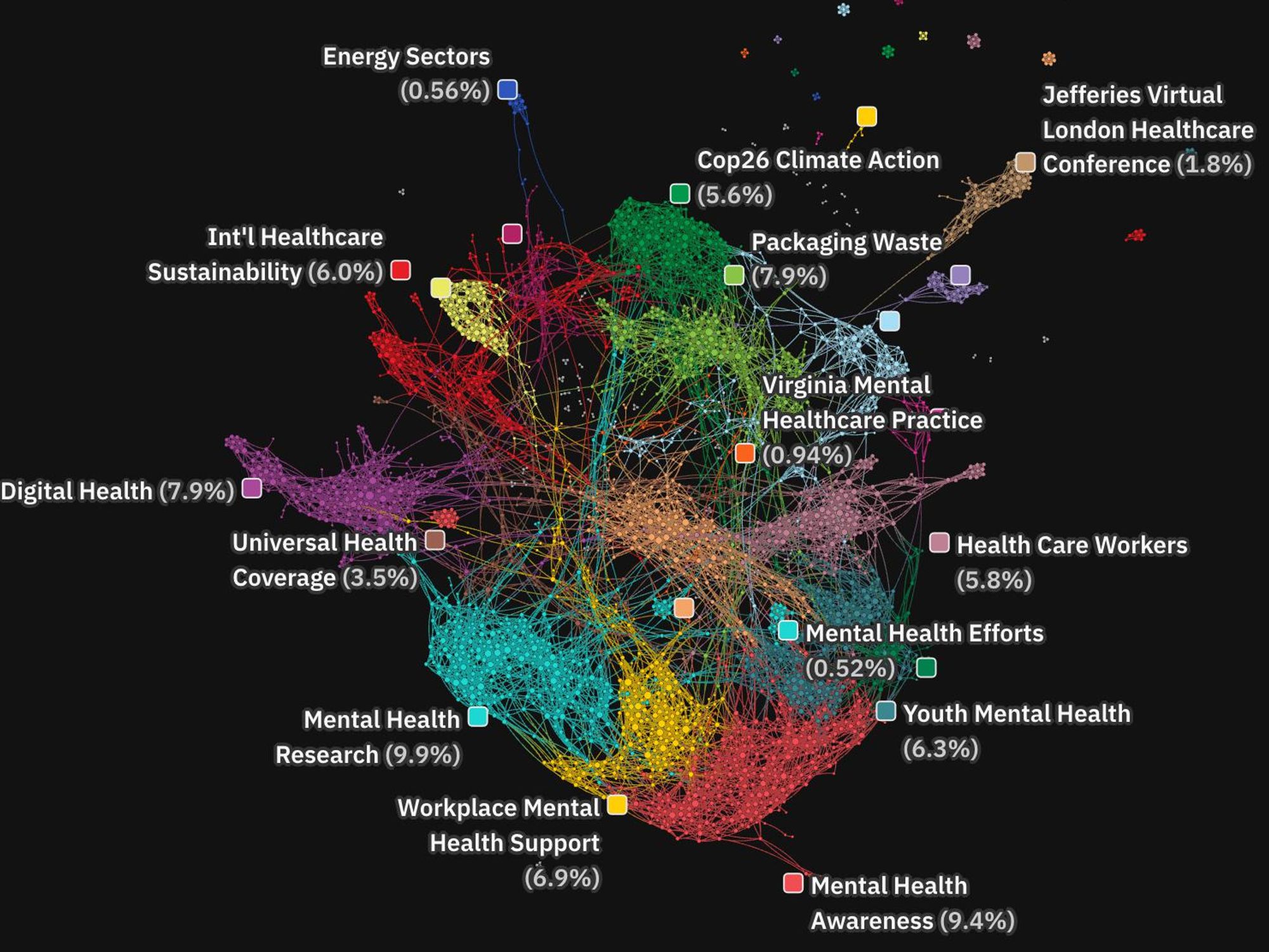
The real shock came when our AI software mapped a representative sample of 2,869 of those stories.
They were all clustered in a tight circle, suggesting a number of shared themes and concepts.
The screengrab above shows all 2,800 stories, sorted by our software into thematic, color-coded clusters, with lines connecting related stories.
Connections with healthcare
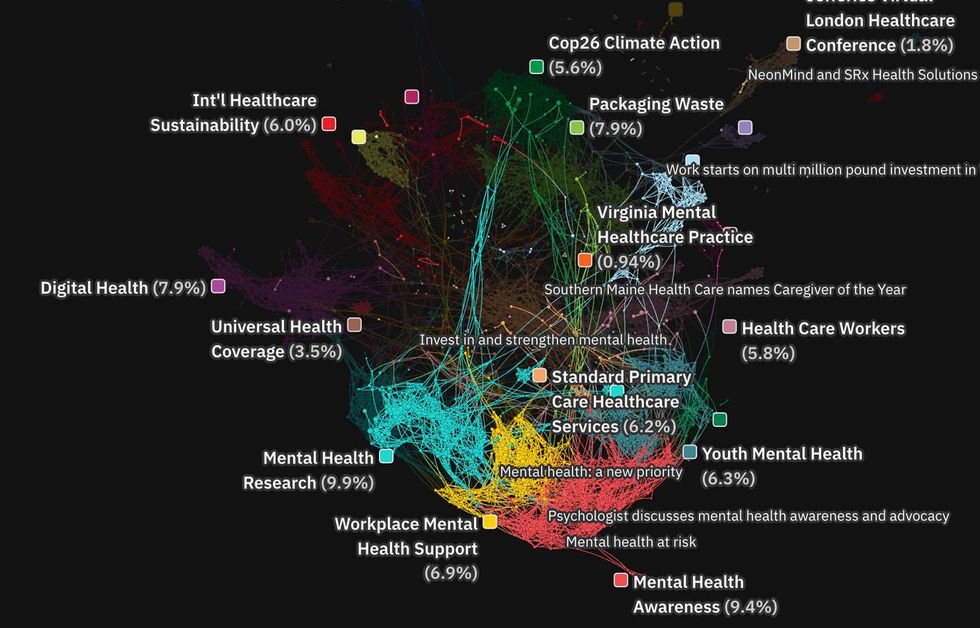
Stories focusing specifically on mental health, highlighted in the above screengrab, sit clustered in the southern hemisphere.
But they're not islands: Many of the mental health clusters spider into and connect with healthcare clusters.
Links to plastic pollution, climate action
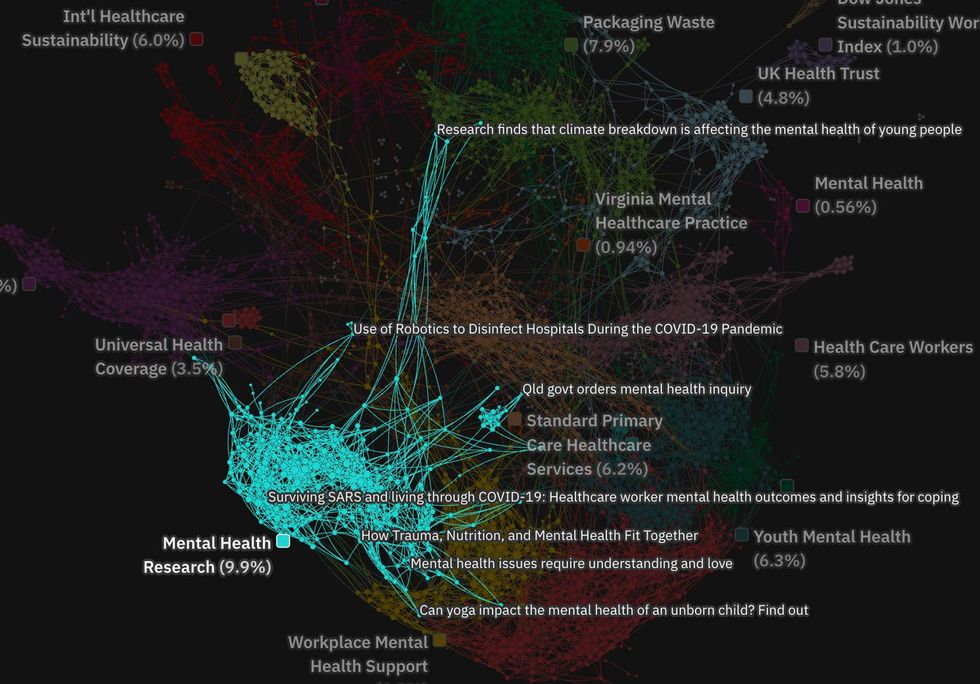
This screengrab highlights one such cluster – stories focusing on mental health research. Notice how the links stretch up and out to touch on clusters focused on plastic pollution, climate action and universal health coverage? That's an encouraging sign.
DEHP and mental health?
I'm not one to say where the promising research or reporting on mental health and sustainable healthcare needs to happen. But I think this area offers rich potential for discovery and discussion.
I think back to an alarming bit of science published earlier this month suggesting that the phthalate DEHP, commonly added to IV tubing and bags, contributes to breast cancer mortality and recurrence.
If you're fighting breast cancer and it flares up again, that's a huge mental burden for you and your loved ones.
And if your healthcare delivery system played a small role in that recurrence? That seems worth exploring.