With dozens of new plastics manufacturing and recycling facilities in the works, the U.S. plastics industry will release more greenhouse gas emissions than coal-fired power plants by 2030, say the authors of a new report.
Emissions from the plastics sector equaled that of 116 coal-fired power plants last year, according to the report out Thursday from Bennington College's Beyond Plastics project. Meanwhile, 42 plastics manufacturing and recycling facilities have opened, or are in the process of being built or permitted, since 2019.
“As the world transitions away from fossil fuels for electricity generation and for transportation, the petrochemical industry has found a new market for fossil fuels: plastics," Judith Enck, president of Beyond Plastics, told reporters on Thursday.
With the U.S. coal industry in decline, the report authors say policymakers at home and at the upcoming COP26 climate summit, a conference happening at the end of month where world leaders will hash out the details of climate pledges, need to factor the climate toll of plastics into emissions reductions efforts.
“Leaving out plastics is leaving out a giant piece of the problem," Enck said. “We would like the national leaders that are gathering in Glasgow, Scotland, to take the plastics issue just as seriously as they are taking transportation and electricity generation."
Climate costs of U.S. plastics
The report authors calculated emissions from 10 stages of plastics production, from hydraulic fracturing, or fracking, for the raw material—ethane in natural gas—all the way up to burning waste in incinerators.
Cracker plants, where natural gas is heated at such high temperatures that it fractures into plastic building blocks like ethylene, have the heaviest emissions toll, producing around 70 million tons of carbon dioxide-equivalent pollutants, which is equal to the emissions of 35 coal-fired power plants. Because the report looks at emissions from a range of greenhouse gases, the authors converted the warming potential of all the pollutants into an equivalent amount of carbon dioxide, the most common greenhouse gas.
The authors say that emissions reports from the plastics industry are incomplete as they don't adequately account for leaks of methane—a greenhouse gas that's 84 times more climate-warming than carbon dioxide in the short-term—and other gases from the transport and production of plastics feedstocks.
They note that while so-called "chemical recycling," which uses large amounts of energy to melt used plastics into building blocks for fuel and other products, is uncommon now, new plants could add up to 18 million tons of carbon dioxide-equivalent pollutants by 2025. Enck referred to chemical recycling as plastics' "new deception" now that Americans are aware that less than 9% of plastics are recycled.
Shipping resins and other plastics building blocks overseas accounts for a significant amount of emissions as well, said Jim Vallette, president of Material Research, the firm that Beyond Plastics hired to do the report analysis. "Plastic is very much like the new coal because the coal industry also is counting on exports to stay alive," he added.
Harmful plastics pollution
Plastics facilities don't just create planet-warming greenhouse gas emissions. They also release benzene, formaldehyde, and the carcinogen ethylene oxide, among other harmful pollutants. The plastics industry has come under fire in recent years for building its polluting plants in poorer parts of the country: 90% of the climate pollution from U.S. plastics plants occurs in just 18 communities that are mostly in Texas and Louisiana, according to the report.
"The health impacts of the emissions are disproportionately borne by low-income communities and communities of color, making this a major environmental justice issue," Enck said.
A GeoHealth report reveals Black people in Richmond experience more heat-related health issues than other groups.
Historical lack of investment in Black neighborhoods contributes to higher temperatures and fewer cooling options.
Many heat-related incidents occur within walking distance of cooling centers, highlighting accessibility issues.
Key quote:
"Spending just a few hours at a cooling center can help prevent heat-related illnesses, but a lot of Richmonders might not know these cooling centers exist or they might not have a safe way to get there."
— Peter Braun, a built environment policy analyst with the Richmond and Henrico Health District
Why this matters:
Urban heat islands and climate change worsen health disparities, particularly in underinvested communities. Black residents, who often live in areas with fewer green spaces and more heat-retaining concrete, are particularly vulnerable. Their neighborhoods frequently lack adequate tree cover and are dotted with aging infrastructure that exacerbates the urban heat island effect. This environmental injustice leads to higher temperatures in these areas, compounding the health risks for the community.
CAMERON PARISH, La. — Late into the night, John Allaire watches the facility next to his home shoot 300-foot flares from stacks.
He lives within eyesight of southwest Louisiana’s salty shores, where, for decades, he’s witnessed nearly 200 feet of land between it and his property line disappear into the sea. Two-thirds of the land was rebuilt to aid the oil and gas industry’s LNG expansion. LNG — shorthand for liquified natural gas – is natural gas that's cooled to liquid form for easier storage or transport; it equates to 1/600th the volume of natural gas in a gaseous state. It’s used to generate electricity, or fuel stove tops and home heaters, and in industrial processes like manufacturing fertilizer.
In the U.S., at least 30 new LNG terminal facilities have been constructed or proposed since 2016, according to the
Oil and Gas Watch project. Louisiana and Texas’ Gulf Coast, where five facilities are already operating, will host roughly two-thirds of the new LNG terminals – meaning at least 22 Gulf Coast LNG facilities are currently under construction, were recently approved to break ground or are under further regulatory review.
Although the U.S. didn’t ship LNG until 2016, when a freight tanker left, a few miles from where Cameron Parish’s LNG plants are today, last year the country became the global leader in LNG production and export volume, leapfrogging exporters like Qatar and Australia. The
EIA’s most recent annual outlook estimated that between the current year and 2050, U.S. LNG exports will increase by 152%.
Allaire, 68, watches how saltwater collects where rainwater once fed the area’s diminishing coastal wetlands. “We still come down here with the kids and set out the fishing rods. It's not as nice as it used to be,” he told
Environmental Health News (EHN).
That intimacy with nature drew Allaire to the area when he purchased 311 acres in 1998. An environmental engineer and 30-year oil and gas industry veteran, he helped lead environmental assessments and manage clean-ups, and although retired, he still works part-time as an environmental consultant with major petroleum companies. With a lifetime of oil and gas industry expertise, he’s watched the industry's footprint spread across Louisiana and the Gulf of Mexico’s fragile shores and beyond. Now that the footprints are at the edge of his backyard, Allaire is among a cohort of organizers, residents and fisher-folk in the region mobilizing to stop LNG facility construction. For him, the industry’s expansion usurps the right-or-wrong ethics he carried across his consulting career. For anglers, oil and gas infrastructure has destroyed fishing grounds and prevented smaller vessels from accessing the seafood-rich waters of the Calcasieu River.
From the view of Allaire’s white pickup truck as he drives across his property to the ocean’s shore, he points to where a new LNG facility will replace marshlands. Commonwealth LNG intends to clear the land of trees and then backfill the remaining low-lying field.
“You see what’s happening with the environment,” Allaire said. “When the facts change, I got to change my mind about what we’re doing.”
Community bands together
John Allaire, left, purchased 311 acres in Cameron Parish in 1998, and has watched the oil and gas industry's footprint spread to his property.
Credit: John Allaire
During an Earth Day rally in April, community members gathered in the urban center of Lake Charles to demand local oil and gas industries help deliver a safer, healthier future for all. In between live acts by artists performing south Louisiana’s quintessential zydeco musical style, speakers like James Hiatt, a Calcasieu Parish native with ties to Cameron Parish and a Healthy Gulf organizer, and RISE St. James organizer Sharon Lavigne, who’s fighting against LNG development in rural Plaquemines Parish near the city of New Orleans, asked the nearly 100 in attendance to imagine a day in which the skyline isn’t dotted by oil and gas infrastructure.
Not long ago, it was hard to imagine an Earth Day rally in southwest Louisiana at all. For decades, the area has been decorated with fossil fuel infrastructure. Sunsets on some days are highlighted by the chemicals in the air; at night, thousands of facilities’ lights dot the dark sky.
“It takes a lot of balls for people to start speaking up,” Shreyas Vasudevan, a campaign researcher with the Louisiana Bucket Brigade, told EHN in the days after the rally. In a region with its history and economy intertwined with oil and gas production, “you can get a lot of social criticism – or ostracization, as well – even threats to your life.”
Many are involved in local, regional and national advocacy groups, including the Louisiana Bucket Brigade, Healthy Gulf, the Sierra Club, the Natural Resources Defense Council, the Turtle Island Restoration Network, the Center for Biological Diversity and the National Audubon Society.
“You see what’s happening with the environment,” Allaire said. “When the facts change, I got to change my mind about what we’re doing.” - John Allaire, environmental engineer and 30-year oil and gas industry veteran
But environmental organizers are fighting a multi-billion-dollar industry with federal and state winds at its back. And LNG’s federal support is coupled with existing state initiatives.
Under outgoing Louisiana Gov. John Bel Edwards — a term-limited Democrat — the state pledged a goal of reaching net-zero greenhouse emissions by 2050. Natural gas, which the LNG industry markets as a cleaner-burning alternative, is cited as one of the state’s solutions. Louisiana is the only state that produces a majority of its carbon emissions through fossil fuels refining industries, like LNG, rather than energy production or transportation. Governor Edwards’ office did not return EHN’s request for comment.
This accommodating attitude towards oil and gas industries has resulted in a workforce that’s trained to work in LNG refining facilities across much of the rural Gulf region, said Steven Miles, a lawyer at Baker Botts LLP and a fellow at the Baker Institute’s Center on Energy Studies. Simultaneously, anti-industrialization pushback is lacking. It’s good news for industries like LNG.
“The bad news,” Miles added. “[LNG facilities] are all being jammed in the same areas.”
One rallying cry for opponents is local health. The Environmental Integrity Project found that LNG export terminals emit chemicals like carbon monoxide –potentially deadly– and sulfur dioxide, of which the American Lung Association says long-term exposure can lead to heart disease, cancer, and damage to internal or female reproductive organs.
An analysis of emissions monitoring reports by the advocacy group the Louisiana Bucket Brigade found that Venture Global’s existing Calcasieu Pass facility had more than 2,000 permit violations.That includes exceeding the permit’s authorized air emissions limit to release nitrogen oxides, carbon monoxide, particulate matter and volatile organic compounds 286 out of its first 343 days of operation.
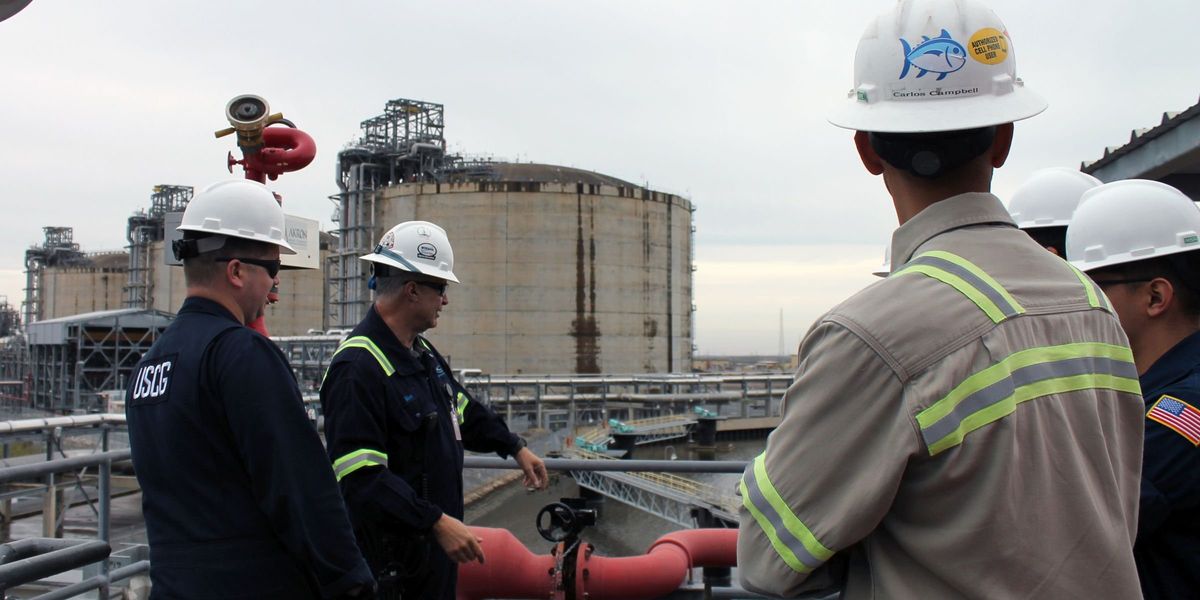
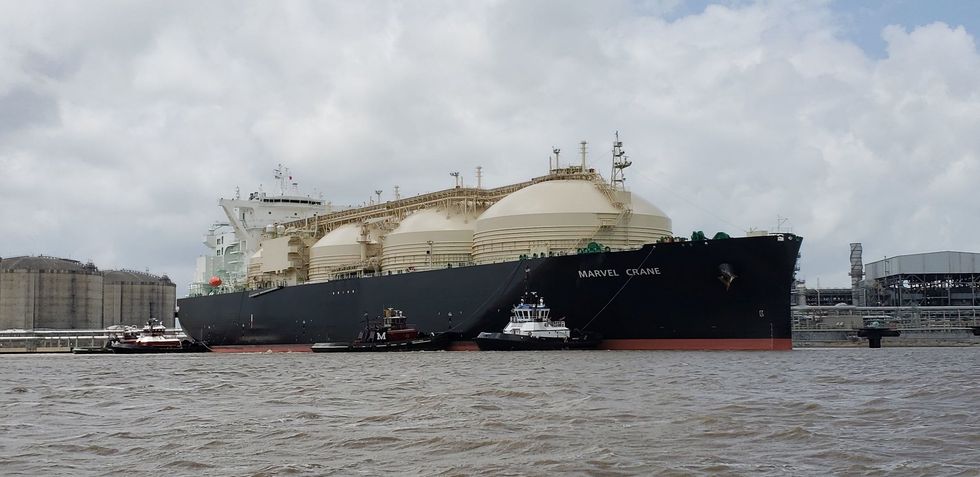
The Marvel Crane, the first liquid natural gas carrier to transport natural gas from the Southwest Louisiana LNG facility, transits a channel in Hackberry, Louisiana, May 28, 2019.
“This is just one facility,” at a time when three more facilities have been proposed in the region and state, Vasudevan said. Venture Global’s operational LNG facility — also known as Calcasieu Pass — “is much smaller than the other facility they’ve proposed.”
In an area that experienced 18 feet of storm surge during Hurricane Laura in 2020 — and just weeks later, struck by Hurricane Delta — Venture Global is planning to build a second export terminal Known as “CP2,” it’s the largest of the roughly two dozen proposed Gulf LNG export terminals, and a key focal point for the region’s local organizing effort.
Residents “don’t really want LNG as much as they want Cameron [Parish] from 1990 back,” Hiatt told EHN of locals’ nostalgia for a community before storms like Rita in 2005 brought up to 15 feet of storm surge, only for Laura to repeat the damage in 2020. Throughout that time, the parish’s population dipped from roughly 10,000 to 5,000. “But the wolf knocking at the door is LNG. Folks in Cameron think that's going to bring back community, bring back the schools, bring back this time before we had all these storms — when Cameron was pretty prosperous.”
“Clearly,” for the oil and gas industry, “the idea is to transform what was once the center of commercial fishing in Louisiana to gas exports,” Cindy Robertson, an environmental activist in southwest Louisiana, told EHN.
Helping fishers’ impacted by LNG is about “actual survival of this unique culture,” Cooke said.
In a measure of organizers’ success, she pointed to a recent permit hearing for Venture Global’s CP2 proposal. Regionally, it’s the only project that’s received an environmental permit, but not its export permit, which remains under federal review. At the meeting, some spoke on the company’s behalf. As an organizer, it was a moment of clarity, Cooke explained. Venture Global officials “had obviously done a lot of coaching and organizing and getting people together in Cameron to speak out on their behalf,” Cooke said. “So, in a way, that was bad. But in another way, it shows that we really had an impact.”
“It also shows that we have a lot to do,” Cooke added.
Environmental organizers like Alyssa Portaro describe a sense of fortitude among activists — she and her husband to the region’s nearby town of Vinton near the Texas-Louisiana border. Since the families’ relocation to their farm, Portaro has worked with Cameron Parish fisher-folk.
“I’ve not witnessed ‘community’ anywhere like there is in Louisiana,” Portaro told EHN. But a New Jersey native, she understands the toll environmental pollution has on low-income communities. “This environment, it’s so at risk — and it’s currently getting sacrificed to big industries.”
“People don’t know what we’d do without oil and gas. It comes at a big price,” she added.
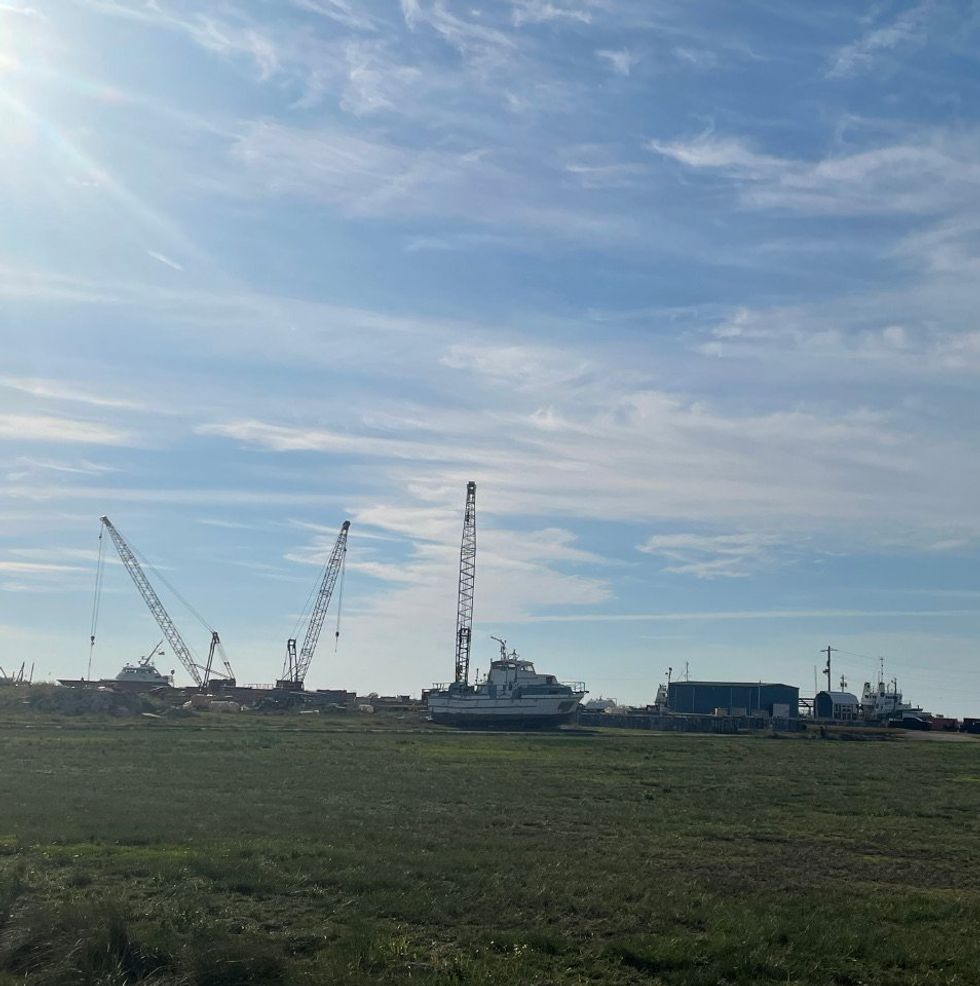
Southwest Louisiana’s Cameron Parish is one of the state’s most rural localities. Marine economies were the area’s economic drivers until natural disasters and LNG facilities began pushing locals out, commercial fishers claim.
Credit: Xander Peters for Environmental Health News
Residents “don’t really want LNG as much as they want Cameron [Parish] from 1990 back,” James Hiatt , a Healthy Gulf organizer, told EHN. "But the wolf knocking at the door is LNG."
Credit: Xander Peters for Environmental Health News
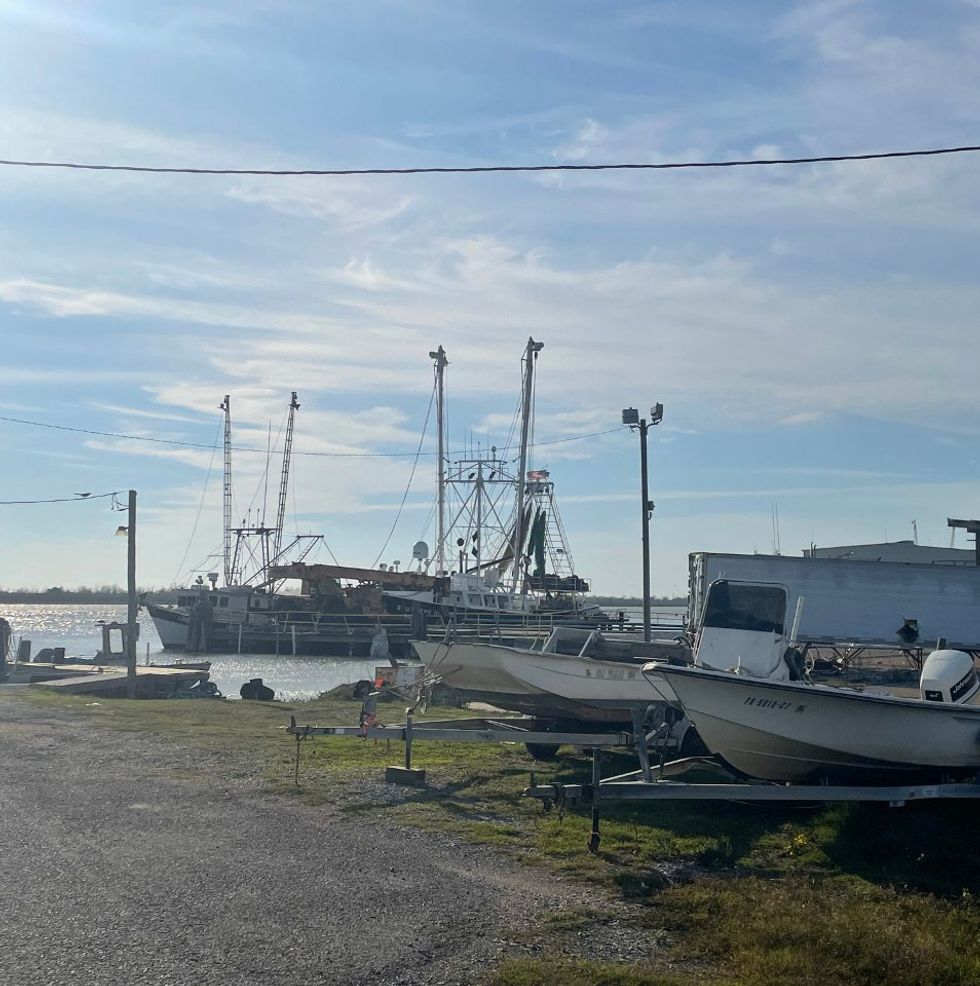
For the most part, Cameron Parish’s life and economy has historically taken place at sea. As new LNG facilities are operational or in planning locally, locals claim the community they once knew is nearly unrecognizable.
Credit: Xander Peters for Environmental Health News
A disappearing parish
The stakes are seemingly higher for a region like southwest Louisiana, which is the epicenter of climate change impacts.
In nearly a century, the state has lost roughly 2,000 square miles of land to coastal erosion. In part driving the state’s erosion crisis is the compounding impacts of Mississippi River infrastructure and oil and gas industry activity, such as dredging canals for shipping purposes, according to a March study published in the journal Nature Sustainability. Louisiana’s Coastal Protection and Restoration Authority said Cameron Parish could lose more land than other coastal parishes over the next 50 years. A recent Climate Central report says the parish will be underwater within that time frame.
On top of erosion and sea level rise impacts, in August, 2023, marshland across southwest Louisiana’s Cameron Parish burned. The fires were among at least 600 across the Bayou State this year. Statewide, roughly 60,000 acres burned — a more than six-fold increase of the state’s average acres burned per year in the past decade alone.
But while the blaze avoided coastal Louisiana communities like Cameron Parish, the fires represented a warning coming from a growing chorus of locals across the region — one that’s echoes by the local commercial fishing population, who claimed to have experienced unusually low yields during the same time, according to a statement from a local environmental group. At the site of the Cameron Parish fires are locations for two proposed LNG expansion projects.
"The idea is to transform what was once the center of commercial fishing in Louisiana to gas exports.” - Cindy Robertson, an environmental activist in southwest Louisiana
It was an unusual occurrence for an area that’s more often itself underwater this time of year due to a storm surge from powerful storms. For LNG expansion’s local opposition, it was a red flag.
As the Louisiana Bucket Brigade has noted prior, the confluence of climate change’s raising of sea levels and the construction of LNG export terminals — some are proposed at the size of nearly 700 football fields — are wiping away the marshland folks like Allaire watched wither. Among their fears is that the future facilities won’t be able to withstand the power of another storm like Laura and its storm surge, which wiped away entire communities in 2020.
Amidst these regional climate impacts, LNG infrastructure has shown potential to exacerbate the accumulation of greenhouse gasses that cause global warming. For the most part, LNG is made up of methane — a greenhouse gas that’s more than 80 times more potent than carbon dioxide in the atmosphere. Among the 22 current LNG facility proposals, the advocacy group Sierra Club described a combined climate pollution output that would roughly equal to that of about 440 coal plants.
The climate impacts prompt some of the LNG industry’s uncertainty going forward. It isn’t clear if Asian countries, key importers of U.S. LNG, will “embrace these energy transition issues,” said David Dismuke, an energy consultant and the former executive director of Louisiana State University’s Center for Energy Studies. Likewise, European nations remain skeptical of embracing LNG as a future staple fuel source.
“They really don't want to have to pull the trigger,” Dismukes added, referring to Europe’s hesitation to commit more resources to exporting LNG from the American market. “They don't want to go down that road.”
While there will be a tapering down of natural gas supply, Miles explained, “we’re going to need natural gas for a long time,” as larger battery storage for renewables is still unavailable.
“I'm not one of these futurists that can tell you where we're going to be, but I just don't see everything being extreme,” Dismukes said. “I don't see what we've already built getting stranded and going away, either.”
For now, LNG seems here to stay. From 2012 to 2022,U.S. natural gas demand — the sum of both domestic consumption and gross exports — rose by a whopping 43%, reported the U.S. Energy Information Administration, or EIA. Meanwhile, in oil and gas hotbeds like Louisiana and Texas, natural gas demand grew by 116%.
Throughout 25 years, Allaire has witnessed southwest Louisiana’s land slowly fade, in part driven by the same industrial spread regionally. Near where the front door of his travel trailer sits underneath the aluminum awning, he points to a chenier ridge located near the end of the property. It’s disappearing, he said.
“See the sand washing over, in here?” Allaire says, as he points towards the stretches of his property. “This pond used to go down for a half mile. This is all that's left of it on this side.”
Vermont farmers, reeling from last summer’s devastating floods, now face an uncertain future as persistent rains continue to threaten their livelihoods.
Last summer’s floods caused nearly $45 million in damages to 264 farms across Vermont, devastating crops and financial stability.
With 70% of farmers lacking crop insurance, many are left relying on inadequate federal disaster loans, adding to their financial burden.
Ongoing weather unpredictability and insufficient government support leave farmers worried about their future sustainability.
Key quote:
“Easy access to loans is a good thing, but when you’ve already borrowed to the point where you know you can’t afford it, it doesn’t solve anybody’s problem.”
— Roy Beckford, director of University of Vermont Extension.
Why this matters:
The resilience of Vermont's agricultural community is being tested as they navigate the challenges of climate change and inadequate support. As forecasts predict more rain, uncertainty looms large, leaving farmers to question their ability to sustain their livelihoods in a flood-prone future. Read more: Soggy springs, scorching summers: Higher temperatures taking toll on US staple crops.
Nearly 3 million Texans lost power due to Hurricane Beryl, with restoration efforts expected to take several days.
The heat index is projected to exceed 100 degrees in some areas, exacerbating health risks for those without air conditioning.
Officials emphasize the urgency of restoring power but face criticism over preparedness and response efforts.
Key quote:
“The power system is a life-saving critical infrastructure — it’s the difference between life and death. The era of nobody could have foreseen these conditions is over.”
— Costa Samaras, a professor of civil and environmental engineering at Carnegie Mellon University
Why this matters:
The combination of extreme heat and prolonged power outages poses severe health risks, especially for vulnerable populations. During these intense heatwaves, air conditioning becomes not just a comfort but a necessity for survival. Yet, power outages strip away this vital lifeline, leaving people to endure sweltering conditions with little relief. Without cooling centers or sufficient emergency measures in place, the risks of heat stroke, dehydration, and other heat-related illnesses skyrocket.
Billionaire Tim Dunn, a Texas oil mogul, is using his wealth to support Donald Trump's bid for the White House, reflecting his desire to influence national politics with his religious and conservative values.
Tim Dunn, CEO of CrownRock, has contributed $5 million to Trump's campaign, making him one of Trump's top donors.
Dunn’s efforts have reshaped Texas politics, financing primary challenges to Republicans who don’t align with his conservative values.
He supports Project 2025, aiming to craft policies for a potential second Trump administration, and is preparing for more influence with an impending $2.2 billion from selling his company.
Key quote:
"The extremists want to deindustrialize America. They want to live in huts around a campfire.”
— Tim Dunn, CEO of CrownRock
Why this matters:
Dunn's involvement in politics emphasizes the increasing influence of wealthy individuals in shaping the country's political landscape. His contributions could amplify Trump's messaging and policy priorities, particularly those favoring the oil industry and conservative social policies. This alignment with Trump also highlights a trend among affluent conservatives who seek to steer the nation’s direction through substantial financial interventions.
Citizen scientists have spent six years helping to track the changes in New Hampshire's coastline, providing crucial data on how different beaches respond to weather events.
Volunteers monitor 15 beach stations, collecting data on elevation and sand volume to understand coastal changes.
Training involves stringent procedures with UNH scientists to ensure accurate data collection.
Findings help identify vulnerable beaches and foster community engagement with coastal science.
Key quote:
“Where are the beaches that need the most help to prevent the worst impacts of storms?”
— Larry Ward, one of the principal investigators of the University of New Hampshire’s Volunteer Beach Profile Monitoring Program
Why this matters:
New Hampshire’s coastline, though short, is a microcosm of broader environmental challenges. As sea levels rise and weather patterns become more erratic due to climate change, understanding how our beaches evolve is more important than ever.
Texas Governor Greg Abbott's recent creation of the 15th Court of Appeals, a body seen as favorable to business interests, has sparked fears among environmental advocates who believe it undermines regulatory oversight.
The new court, established by the Texas Legislature, will hear civil cases involving the state and significant business disputes.
Environmentalists worry the court will bypass the more progressive 3rd Court of Appeals, which has historically been more sympathetic to environmental concerns.
High-stakes cases, including those involving major pollution permits, will now be handled by the new court, potentially weakening environmental protections.
Key quote:
“This is a way for Texas to create a very conservative court that I suspect the governor believes will be less friendly to environmental interests and probably very friendly to business.”
— Ilan Levin, senior counsel, Environmental Integrity Project.
As mounds of dredged material from the Houston Ship Channel dot their neighborhoods, residents are left without answers as to what dangers could be lurking.