Joe Biden broke with tradition in his State of the Union address by offering more than a throwaway platitude or two on climate change.
Here are three past examples from consecutive decades:
In 1984, Ronald Reagan said “Preservation of our environment is not a liberal or conservative challenge, it's common sense.”
In Bill Clinton’s first State of the Union speech in 1993, the Democratic president was moved to speak ill of a blockbuster environmental law. "I'd like to use that Superfund to clean up pollution for a change and not just pay lawyers."
And in 2006, George W. Bush looked America in the eye and pronounced his nation “addicted to oil.”
Those are my favorites among many broken SOTU vows. Of course, Reagan’s call for eco-unity came when he had already appointed uber-divisive souls like James Watt at the Department of the Interior and Anne Gorsuch at the Environmental Protection Agency. Clinton’s Superfund vow is still largely unfulfilled by either party.
And Bush’s oil addiction? Puh-leeze.
Climate crickets
On Monday, the scientists on the United Nations' Intergovernmental Panel on Climate Change (IPCC) served up their most stark, incontrovertible, poop-in-your-pants outlook on the certainties of the climate crisis.
The world filed it behind Ukraine, COVID, and other more recent hair-on-fire issues on the action list. And maybe that’s where it belongs—for a couple of weeks at most.
The next AWOL
We’re just now coming to terms with the plastic crisis, as nations signed on to the beginning of a treaty process that will stop kicking the PET bottle down the road in 2024.
In the meantime, one estimate says we each ingest a credit card’s worth of microplastics each week. Think of a stack of 104 credit cards in your innards until the treaty kicks in ...
And finally, a big OMG
I’ve had an occasional, surprisingly good-natured back-and-forth with Senator Jim Inhofe, unofficial Dean of the Congressional Climate Denial Caucus.
To be fair, Inhofe can be courtly and good-natured, even in dialogue with those who think his views on climate change are based more on hallucination than on science. And maybe it’s in that spirit that he accepted my request for an interview on what he calls the climate “hoax.” On Friday November 17, 2034, at 10:30am ET, assuming we’re both alive, I’ll interview the ex-Senator on the occasion of his 100th birthday as to how the hoax is going.
Perhaps understandably, Inhofe’s announcement last week that he’s leaving the Senate at year’s end was a full fledged OMG. He’ll turn 88 before heading home to the only American state with an oil derrick on the Capitol’s front lawn.
Maybe he’ll take the time to notice that Oklahoma is the only state, as the hit Broadway musical tells us, where the wind comes sweepin’ down the plain.
Peter Dykstra is our weekend editor and columnist and can be reached at pdykstra@ehn.org or @pdykstra.
His views do not necessarily represent those of Environmental Health News, The Daily Climate, or publisher Environmental Health Sciences.
“It’s a little ironic that they’re coming to the U.S. and buying a company facing all the same problems they’re facing in Japan.”
During a shareholders meeting in Tokyo last Friday, a group of investors in Nippon Steel asked the company to improve its decarbonization strategy and reduce harmful emissions in light of its pending acquisition of U.S. Steel.
Nippon Steel, the largest steel producer in Japan and the fourth-largest in the world, is set to purchase U.S. Steel pending regulatory approval by the US government. The sale is controversial because the United Steelworkers Union strongly opposes it, and has sparked an international political debate over whether U.S. Steel should remain “American owned.”
A group of concerned investors say that Nippon Steel’s purchase of U.S. Steel, which still relies heavily on coal-based steel production at its 11 blast furnaces in the Pittsburgh region, is part of a pattern indicating the company has a “coal addiction.” Nippon Steel has also been buying up coal mines in other parts of the world, and recently started construction on two new blast furnaces in India.
“Steel does not have a climate problem, it has a coal problem,” Brynn O’Brien, executive director of the Australasian Centre for Corporate Responsibility, one of the investment groups calling for changes at Nippon Steel, told EHN. “Shareholders should note neither U.S. Steel nor Nippon Steel have Paris-aligned targets, and the potential addition of U.S. Steel’s 11 blast furnaces to Nippon Steel’s operations will place more pressure on the company to demonstrate to shareholders it has a credible decarbonization strategy.”
O’Brien’s organization, along with the investment groups Corporate Action Japan and Legal & General Investment Management, filed three shareholder proposals ahead of last Friday’s meeting. The proposals asked Nippon Steel to set and disclose short and medium-term greenhouse gas emissions reduction targets aligned with the Paris Agreement, requested that executive profits be linked to the company’s emissions reduction targets (something other steel companies have already done) and asked for increased disclosure of climate-related lobbying activities.
When the proposals were presented at last Friday’s shareholder meeting, they were met with applause from other shareholders, according to people who were present.
“I think that’s a sign of the times that there’s increasing awareness that Nippon Steel has a climate problem it needs to get serious about, and that’s the message these investors sent,” Roger Smith, Asia lead for SteelWatch, an industry watchdog and climate advocacy group, told EHN.
The filing of the proposals came after a group of institutional investors collectively representing nearly $5 trillion of assets informally asked Nippon Steel for more environmental accountability last year, according to the Australasian Centre for Corporate Responsibility. The formal proposals were also supported by the large institutional investment firms Amundi, Nordea Asset Management and Storebrand Asset Management.
“Steel does not have a climate problem, it has a coal problem." — Brynn O’Brien, Australasian Centre for Corporate Responsibility
The proposals didn’t garner enough votes to be adopted at last Friday’s shareholder meeting, but about 21% of shareholders voted in support of the proposal to align emission goals with the Paris Agreement, 23% of shareholders voted in support of the proposal requesting that shareholder profits be linked to the company’s emission reduction targets and 28% of shareholders voted in favor of the proposal on improved disclosure of climate-related lobbying.
In Japan, climate-related shareholder proposals require a majority of two-thirds of the votes of the shareholders present in order to be adopted, according to O’Brien.
“Not meeting this threshold does not mean a company can or will disregard significant support for a proposal,” he said. “Given the significant shareholder support for all three proposals, we expect Nippon Steel to respond to this strong investor feedback… Good corporate governance requires, at a minimum, the company to analyze the reasons for the vote and consider how its strategy needs to evolve in line with investor expectations.”
Nippon Steel did not immediately respond to a request for comment on the shareholder proposals or its decarbonization strategy.
A competitive disadvantage
While the shareholders who filed the proposals raised climate and public health concerns, their primary concern was financial.
The support for the climate-related proposals at the shareholders meeting “is evidence that investors see a strong link between a credible decarbonization strategy and securing corporate value,” O’Brien said. “Continuing coal investment risks stranded assets, regulatory penalties and competitive disadvantages as global markets shift towards green steel production.”
The Paris Agreement has shifted the steel market dramatically, Smith said.
“It’s now the expectation of governments and steel buyers that low-emission steel will soon be available, and ultimately that will either be requested or required,” Smith said. “Some of Nippon Steel’s biggest rivals have plans to produce green steel in the next few years, but Nippon Steel has nothing to compete with that. They have no low-emissions primary steel, nor do they have any plans to produce it in the near future.”
O’Brien noted that while U.S. Steel’s Pennsylvania plants are problematic, Nippon Steel’s decarbonization strategy would benefit from acquiring the company’s electric arc furnace facilities in Alabama, which have a significantly lower carbon footprint and are necessary for the production of green steel.
“That doesn’t resolve shareholder concerns about making continued investments in coal-based facilities,” Smith said. “Investors need to know, is this just a dead end? Are you just going to run the blast furnaces into the ground and then walk away?”
The steel industry’s critical role in meeting global climate targets
“I don’t think they’re going to care about us," Natalie Morris, a resident of Braddock who lives near U.S. Steel’s Edgar Thomson Mill, told EHN during a protest last month over the sale to Nippon Steel.
Credit: Kristina Marusic for EHN
Steel production is responsible for an estimated 7% of all human-made greenhouse gas emissions, and is the largest greenhouse gas emitter in the manufacturing sector. The steel industry’s carbon footprint impacts other major industries, including construction, transportation and energy production, so shrinking the industry’s emissions could also “substantially cut emissions for all those industries dependent on steel,” according to the World Economic Forum.
Both U.S. Steel and Nippon Steel have set goals of being carbon neutral by 2050, but both companies have been criticized for lacking concrete plans to reach that goal, for their continued reliance on coal when cleaner technologies are available and for that timeline being too slow to achieve the 1.5°C global warming limit established by the Paris Climate Agreement.
The MSCI Global Sustainability Index rates Nippon Steel’s projected emissions as being aligned with more than 3.2°C of global warming, indicating that the company’s “contribution to catastrophic climate change is higher than most.”
“It wouldn’t be a livable planet if every company did that,” Smith told EHN.
U.S. Steel doesn’t have an MSCI rating, but has been ranked “high risk” for investors concerned about sustainability by the investment research firm Morningstar.
“It’s a little ironic that Nippon Steel is coming to the U.S. and buying a company that’s facing all the same problems they’re facing in Japan,” Smith said.
The shareholders plan to continue applying pressure.
“There are further escalation tools available to shareholders, including voting on directors, if insufficient progress is made,” O’Brien said. “Investors want confidence that Nippon Steel is going to remain competitive into the future, and there is strong commitment to ensuring corporate value is secured.”
CAMERON PARISH, La. — Late into the night, John Allaire watches the facility next to his home shoot 300-foot flares from stacks.
He lives within eyesight of southwest Louisiana’s salty shores, where, for decades, he’s witnessed nearly 200 feet of land between it and his property line disappear into the sea. Two-thirds of the land was rebuilt to aid the oil and gas industry’s LNG expansion. LNG — shorthand for liquified natural gas – is natural gas that's cooled to liquid form for easier storage or transport; it equates to 1/600th the volume of natural gas in a gaseous state. It’s used to generate electricity, or fuel stove tops and home heaters, and in industrial processes like manufacturing fertilizer.
In the U.S., at least 30 new LNG terminal facilities have been constructed or proposed since 2016, according to the
Oil and Gas Watch project. Louisiana and Texas’ Gulf Coast, where five facilities are already operating, will host roughly two-thirds of the new LNG terminals – meaning at least 22 Gulf Coast LNG facilities are currently under construction, were recently approved to break ground or are under further regulatory review.
Although the U.S. didn’t ship LNG until 2016, when a freight tanker left, a few miles from where Cameron Parish’s LNG plants are today, last year the country became the global leader in LNG production and export volume, leapfrogging exporters like Qatar and Australia. The
EIA’s most recent annual outlook estimated that between the current year and 2050, U.S. LNG exports will increase by 152%.
Allaire, 68, watches how saltwater collects where rainwater once fed the area’s diminishing coastal wetlands. “We still come down here with the kids and set out the fishing rods. It's not as nice as it used to be,” he told
Environmental Health News (EHN).
That intimacy with nature drew Allaire to the area when he purchased 311 acres in 1998. An environmental engineer and 30-year oil and gas industry veteran, he helped lead environmental assessments and manage clean-ups, and although retired, he still works part-time as an environmental consultant with major petroleum companies. With a lifetime of oil and gas industry expertise, he’s watched the industry's footprint spread across Louisiana and the Gulf of Mexico’s fragile shores and beyond. Now that the footprints are at the edge of his backyard, Allaire is among a cohort of organizers, residents and fisher-folk in the region mobilizing to stop LNG facility construction. For him, the industry’s expansion usurps the right-or-wrong ethics he carried across his consulting career. For anglers, oil and gas infrastructure has destroyed fishing grounds and prevented smaller vessels from accessing the seafood-rich waters of the Calcasieu River.
From the view of Allaire’s white pickup truck as he drives across his property to the ocean’s shore, he points to where a new LNG facility will replace marshlands. Commonwealth LNG intends to clear the land of trees and then backfill the remaining low-lying field.
“You see what’s happening with the environment,” Allaire said. “When the facts change, I got to change my mind about what we’re doing.”
Community bands together
John Allaire, left, purchased 311 acres in Cameron Parish in 1998, and has watched the oil and gas industry's footprint spread to his property.
Credit: John Allaire
During an Earth Day rally in April, community members gathered in the urban center of Lake Charles to demand local oil and gas industries help deliver a safer, healthier future for all. In between live acts by artists performing south Louisiana’s quintessential zydeco musical style, speakers like James Hiatt, a Calcasieu Parish native with ties to Cameron Parish and a Healthy Gulf organizer, and RISE St. James organizer Sharon Lavigne, who’s fighting against LNG development in rural Plaquemines Parish near the city of New Orleans, asked the nearly 100 in attendance to imagine a day in which the skyline isn’t dotted by oil and gas infrastructure.
Not long ago, it was hard to imagine an Earth Day rally in southwest Louisiana at all. For decades, the area has been decorated with fossil fuel infrastructure. Sunsets on some days are highlighted by the chemicals in the air; at night, thousands of facilities’ lights dot the dark sky.
“It takes a lot of balls for people to start speaking up,” Shreyas Vasudevan, a campaign researcher with the Louisiana Bucket Brigade, told EHN in the days after the rally. In a region with its history and economy intertwined with oil and gas production, “you can get a lot of social criticism – or ostracization, as well – even threats to your life.”
Many are involved in local, regional and national advocacy groups, including the Louisiana Bucket Brigade, Healthy Gulf, the Sierra Club, the Natural Resources Defense Council, the Turtle Island Restoration Network, the Center for Biological Diversity and the National Audubon Society.
“You see what’s happening with the environment,” Allaire said. “When the facts change, I got to change my mind about what we’re doing.” - John Allaire, environmental engineer and 30-year oil and gas industry veteran
But environmental organizers are fighting a multi-billion-dollar industry with federal and state winds at its back. And LNG’s federal support is coupled with existing state initiatives.
Under outgoing Louisiana Gov. John Bel Edwards — a term-limited Democrat — the state pledged a goal of reaching net-zero greenhouse emissions by 2050. Natural gas, which the LNG industry markets as a cleaner-burning alternative, is cited as one of the state’s solutions. Louisiana is the only state that produces a majority of its carbon emissions through fossil fuels refining industries, like LNG, rather than energy production or transportation. Governor Edwards’ office did not return EHN’s request for comment.
This accommodating attitude towards oil and gas industries has resulted in a workforce that’s trained to work in LNG refining facilities across much of the rural Gulf region, said Steven Miles, a lawyer at Baker Botts LLP and a fellow at the Baker Institute’s Center on Energy Studies. Simultaneously, anti-industrialization pushback is lacking. It’s good news for industries like LNG.
“The bad news,” Miles added. “[LNG facilities] are all being jammed in the same areas.”
One rallying cry for opponents is local health. The Environmental Integrity Project found that LNG export terminals emit chemicals like carbon monoxide –potentially deadly– and sulfur dioxide, of which the American Lung Association says long-term exposure can lead to heart disease, cancer, and damage to internal or female reproductive organs.
An analysis of emissions monitoring reports by the advocacy group the Louisiana Bucket Brigade found that Venture Global’s existing Calcasieu Pass facility had more than 2,000 permit violations.That includes exceeding the permit’s authorized air emissions limit to release nitrogen oxides, carbon monoxide, particulate matter and volatile organic compounds 286 out of its first 343 days of operation.
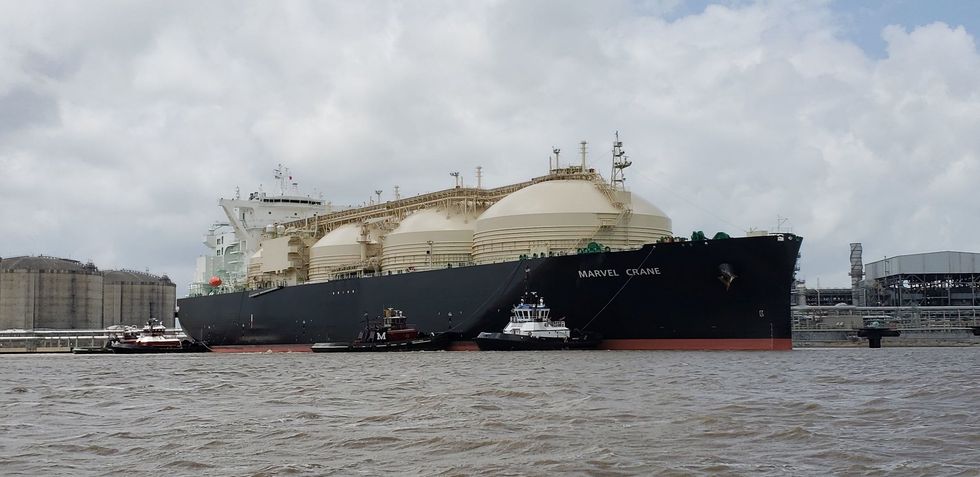
The Marvel Crane, the first liquid natural gas carrier to transport natural gas from the Southwest Louisiana LNG facility, transits a channel in Hackberry, Louisiana, May 28, 2019.
“This is just one facility,” at a time when three more facilities have been proposed in the region and state, Vasudevan said. Venture Global’s operational LNG facility — also known as Calcasieu Pass — “is much smaller than the other facility they’ve proposed.”
In an area that experienced 18 feet of storm surge during Hurricane Laura in 2020 — and just weeks later, struck by Hurricane Delta — Venture Global is planning to build a second export terminal Known as “CP2,” it’s the largest of the roughly two dozen proposed Gulf LNG export terminals, and a key focal point for the region’s local organizing effort.
Residents “don’t really want LNG as much as they want Cameron [Parish] from 1990 back,” Hiatt told EHN of locals’ nostalgia for a community before storms like Rita in 2005 brought up to 15 feet of storm surge, only for Laura to repeat the damage in 2020. Throughout that time, the parish’s population dipped from roughly 10,000 to 5,000. “But the wolf knocking at the door is LNG. Folks in Cameron think that's going to bring back community, bring back the schools, bring back this time before we had all these storms — when Cameron was pretty prosperous.”
“Clearly,” for the oil and gas industry, “the idea is to transform what was once the center of commercial fishing in Louisiana to gas exports,” Cindy Robertson, an environmental activist in southwest Louisiana, told EHN.
Helping fishers’ impacted by LNG is about “actual survival of this unique culture,” Cooke said.
In a measure of organizers’ success, she pointed to a recent permit hearing for Venture Global’s CP2 proposal. Regionally, it’s the only project that’s received an environmental permit, but not its export permit, which remains under federal review. At the meeting, some spoke on the company’s behalf. As an organizer, it was a moment of clarity, Cooke explained. Venture Global officials “had obviously done a lot of coaching and organizing and getting people together in Cameron to speak out on their behalf,” Cooke said. “So, in a way, that was bad. But in another way, it shows that we really had an impact.”
“It also shows that we have a lot to do,” Cooke added.
Environmental organizers like Alyssa Portaro describe a sense of fortitude among activists — she and her husband to the region’s nearby town of Vinton near the Texas-Louisiana border. Since the families’ relocation to their farm, Portaro has worked with Cameron Parish fisher-folk.
“I’ve not witnessed ‘community’ anywhere like there is in Louisiana,” Portaro told EHN. But a New Jersey native, she understands the toll environmental pollution has on low-income communities. “This environment, it’s so at risk — and it’s currently getting sacrificed to big industries.”
“People don’t know what we’d do without oil and gas. It comes at a big price,” she added.
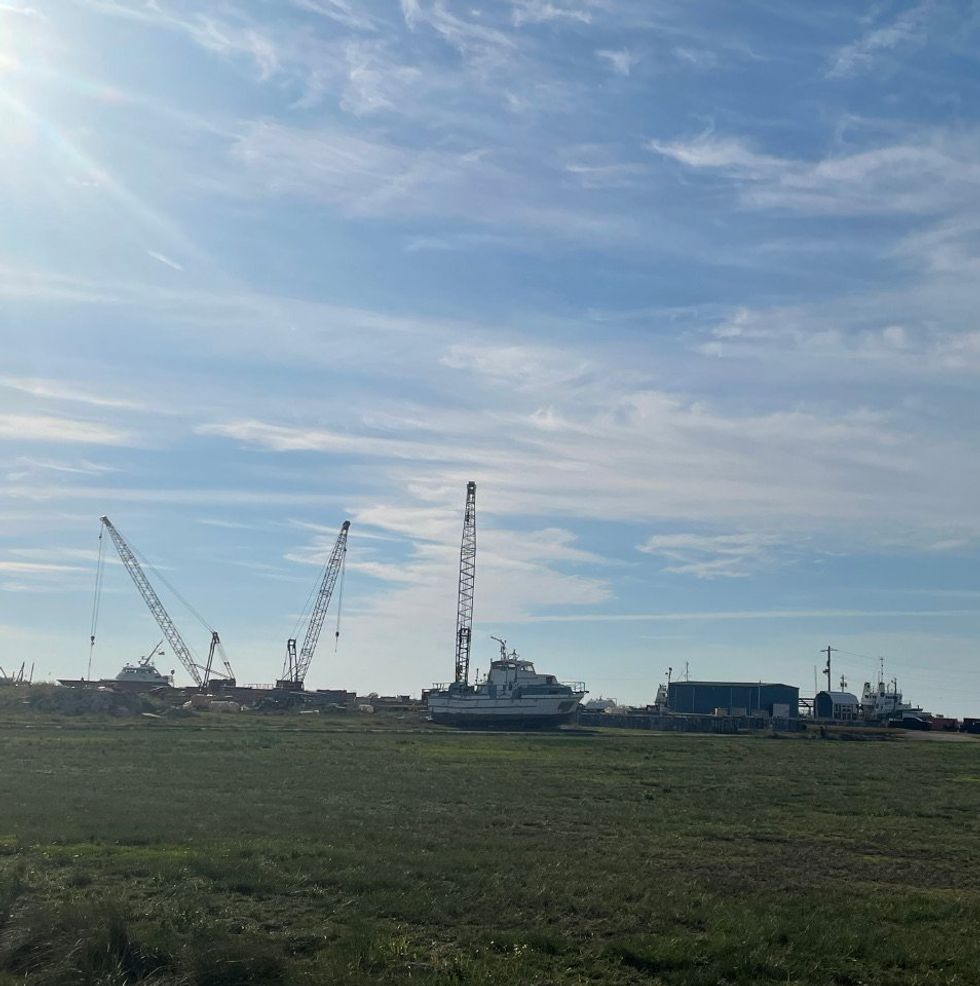
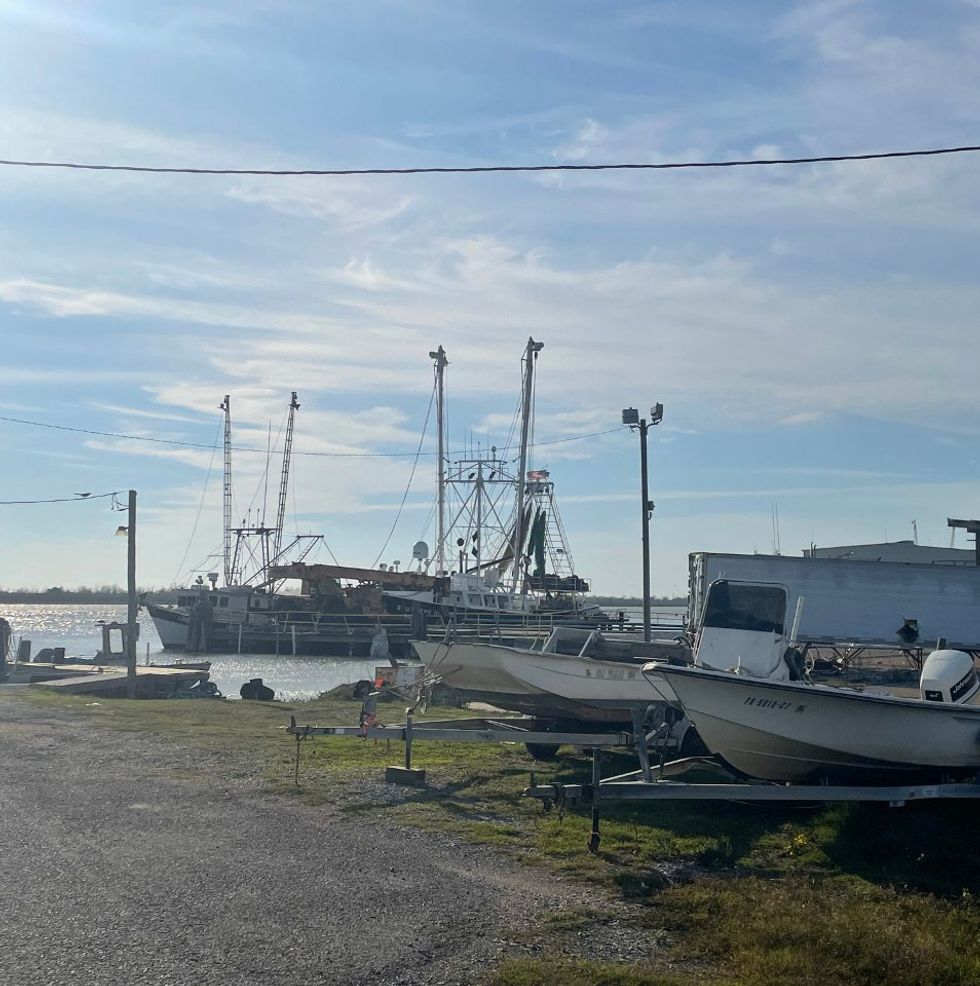
Southwest Louisiana’s Cameron Parish is one of the state’s most rural localities. Marine economies were the area’s economic drivers until natural disasters and LNG facilities began pushing locals out, commercial fishers claim.
Credit: Xander Peters for Environmental Health News
Residents “don’t really want LNG as much as they want Cameron [Parish] from 1990 back,” James Hiatt , a Healthy Gulf organizer, told EHN. "But the wolf knocking at the door is LNG."
Credit: Xander Peters for Environmental Health News
For the most part, Cameron Parish’s life and economy has historically taken place at sea. As new LNG facilities are operational or in planning locally, locals claim the community they once knew is nearly unrecognizable.
Credit: Xander Peters for Environmental Health News
A disappearing parish
The stakes are seemingly higher for a region like southwest Louisiana, which is the epicenter of climate change impacts.
In nearly a century, the state has lost roughly 2,000 square miles of land to coastal erosion. In part driving the state’s erosion crisis is the compounding impacts of Mississippi River infrastructure and oil and gas industry activity, such as dredging canals for shipping purposes, according to a March study published in the journal Nature Sustainability. Louisiana’s Coastal Protection and Restoration Authority said Cameron Parish could lose more land than other coastal parishes over the next 50 years. A recent Climate Central report says the parish will be underwater within that time frame.
On top of erosion and sea level rise impacts, in August, 2023, marshland across southwest Louisiana’s Cameron Parish burned. The fires were among at least 600 across the Bayou State this year. Statewide, roughly 60,000 acres burned — a more than six-fold increase of the state’s average acres burned per year in the past decade alone.
But while the blaze avoided coastal Louisiana communities like Cameron Parish, the fires represented a warning coming from a growing chorus of locals across the region — one that’s echoes by the local commercial fishing population, who claimed to have experienced unusually low yields during the same time, according to a statement from a local environmental group. At the site of the Cameron Parish fires are locations for two proposed LNG expansion projects.
"The idea is to transform what was once the center of commercial fishing in Louisiana to gas exports.” - Cindy Robertson, an environmental activist in southwest Louisiana
It was an unusual occurrence for an area that’s more often itself underwater this time of year due to a storm surge from powerful storms. For LNG expansion’s local opposition, it was a red flag.
As the Louisiana Bucket Brigade has noted prior, the confluence of climate change’s raising of sea levels and the construction of LNG export terminals — some are proposed at the size of nearly 700 football fields — are wiping away the marshland folks like Allaire watched wither. Among their fears is that the future facilities won’t be able to withstand the power of another storm like Laura and its storm surge, which wiped away entire communities in 2020.
Amidst these regional climate impacts, LNG infrastructure has shown potential to exacerbate the accumulation of greenhouse gasses that cause global warming. For the most part, LNG is made up of methane — a greenhouse gas that’s more than 80 times more potent than carbon dioxide in the atmosphere. Among the 22 current LNG facility proposals, the advocacy group Sierra Club described a combined climate pollution output that would roughly equal to that of about 440 coal plants.
The climate impacts prompt some of the LNG industry’s uncertainty going forward. It isn’t clear if Asian countries, key importers of U.S. LNG, will “embrace these energy transition issues,” said David Dismuke, an energy consultant and the former executive director of Louisiana State University’s Center for Energy Studies. Likewise, European nations remain skeptical of embracing LNG as a future staple fuel source.
“They really don't want to have to pull the trigger,” Dismukes added, referring to Europe’s hesitation to commit more resources to exporting LNG from the American market. “They don't want to go down that road.”
While there will be a tapering down of natural gas supply, Miles explained, “we’re going to need natural gas for a long time,” as larger battery storage for renewables is still unavailable.
“I'm not one of these futurists that can tell you where we're going to be, but I just don't see everything being extreme,” Dismukes said. “I don't see what we've already built getting stranded and going away, either.”
For now, LNG seems here to stay. From 2012 to 2022,U.S. natural gas demand — the sum of both domestic consumption and gross exports — rose by a whopping 43%, reported the U.S. Energy Information Administration, or EIA. Meanwhile, in oil and gas hotbeds like Louisiana and Texas, natural gas demand grew by 116%.
Throughout 25 years, Allaire has witnessed southwest Louisiana’s land slowly fade, in part driven by the same industrial spread regionally. Near where the front door of his travel trailer sits underneath the aluminum awning, he points to a chenier ridge located near the end of the property. It’s disappearing, he said.
“See the sand washing over, in here?” Allaire says, as he points towards the stretches of his property. “This pond used to go down for a half mile. This is all that's left of it on this side.”
In a CNN-hosted debate, climate change was mentioned briefly, with Biden highlighting the Inflation Reduction Act and Trump offering an incoherent response.
Biden pointed to his administration’s clean energy policies, notably the Inflation Reduction Act and the creation of the American Climate Corps.
Trump avoided a direct answer, instead boasting about environmental numbers and criticizing the Paris Agreement.
Climate experts were disappointed by the debate's lack of substantial discussion on climate change.
Key quote:
“More time discussing golf than climate. What a world we are living in.”
— Jeff Goodell, author of The Heat Will Kill You First
Why this matters:
Climate change remains a critical issue with far-reaching health and environmental impacts. This debate highlighted the stark contrast between the candidates' approaches, emphasizing the election’s significance for future climate policy. More reading: Trump’s other war is going well.
Former President Donald Trump criticizes President Biden's renewable energy policies, which experts say could inadvertently benefit China by jeopardizing $488 billion in U.S. manufacturing investments.
Trump has labeled Biden's renewable energy policies as a ploy to enrich China, as China controls many parts needed for green technology.
Experts argue repealing these policies would hurt U.S. manufacturing, boosting China's edge in clean energy technologies.
The Inflation Reduction Act has spurred $488 billion in U.S. investments, creating significant job growth in renewable energy sectors.
Key quote:
"If America chooses as a matter of political decision to go backward on the green transition, it won’t stop the global process because that’s already underway."
— Stuart P.M. Mackintosh, economist and author of the book "Climate Crisis Economics"
Why this matters:
Proponents of Biden's policies argue that the long-term benefits of renewable energy outweigh the risks. They emphasize that investing in green technology can spur innovation, create sustainable jobs and reduce dependency on foreign energy sources. Moreover, the environmental benefits of reducing carbon emissions and promoting clean energy are seen as vital steps in addressing the climate crisis.
The Supreme Court has put a hold on the EPA's "good neighbor" plan, which aimed to cut ozone pollution from Western and Midwestern states affecting Eastern states.
The ruling was a narrow 5-4 decision, with Justice Gorsuch writing for the majority, stating the stay will remain until a federal appeals court reviews the matter.
Justice Barrett, dissenting, warned that the decision would allow continued pollution, impacting downwind states' air quality and public health.
Key quote:
“The court’s extraordinary decision today to grant an emergency stay is a travesty of justice that puts the lives and health of millions of people at risk.”
— Vickie Patton, general counsel of the Environmental Defense Fund
The justices are set to rule on four cases affecting environmental protections, including EPA's cross-state smog controls and the Chevron doctrine.
The 40-year-old Chevron doctrine, which allows agencies to interpret laws, is under threat, potentially altering long-standing regulatory practices.
A separate case could open old federal rules to new legal challenges, creating the possibility of reopening old cases.
Key quote:
“Brace for impact.”
— Michael Waldman, president of the Brennan Center for Justice in a recent analysis.
Advertisement
Why this matters:
As the court deliberates, the outcomes will be closely watched by a diverse array of stakeholders, including health professionals, environmental advocates and industry leaders. The decisions could set new precedents for how far federal agencies can go in implementing measures to protect the environment, impacting everything from industrial emissions to natural resource management.
Environmental protests are increasingly met with severe repression and criminalization, threatening democracy and human rights, according to UN special rapporteur Michel Forst.
Europe has seen a surge in police brutality and heavy-handed legal measures against environmental defenders, often using outdated or new restrictive laws.
Public discourse often labels environmental activists as "eco-terrorists" or "green Talibans," inciting public and media hostility.
Countries like Italy, Germany and the UK employ laws to criminalize peaceful protests, with harsh sentences and severe legal penalties.
Key quote:
"In terms of freedom of speech and the right to protest, certainly in regards to climate change, the world is moving in the wrong direction."
— Michel Forst, UN special rapporteur on environmental defenders.
Why this matters:
The repression of environmental activists undermines basic human rights and stifles efforts to address climate change. This atmosphere of fear can stymie broader civic engagement and deter necessary actions to address environmental crises. At a time when urgent action is needed to combat climate change and environmental degradation, silencing activists could have negative consequences for the planet and future generations.