I spent nearly 20 years cashing paychecks from commercial TV, vainly hoping for the day when our environment would be front and center.
It would seem that day is here.
But it’s nothing like I imagined: It’s in ad breaks, where nature awaits in abundance to make us rich, or make us healthy, or kill us. Let me count the ways.
Gold: Hollywood geezers like William Devane pitch us in TV ads on gold, an investment so safe it’s been locked underground for eons. Gold, we’re told, is a hedge against global instability. By the way, modern gold mining often employs cyanide to leach out gold flakes.
Glyphosate: Following a blockbuster $275 million jury verdict in a 2019 case involving a gardener’s health claims, trial lawyers’ interest grew from a flock to a swarm. Much larger class action suits with potential payouts in the billions emerged. Broadcasters and website operators as a rule don’t disclose ad sales figures, but the American Tort Reform Association says glyphosate law firms have spent $131 million on 625,000 ads since 2015.
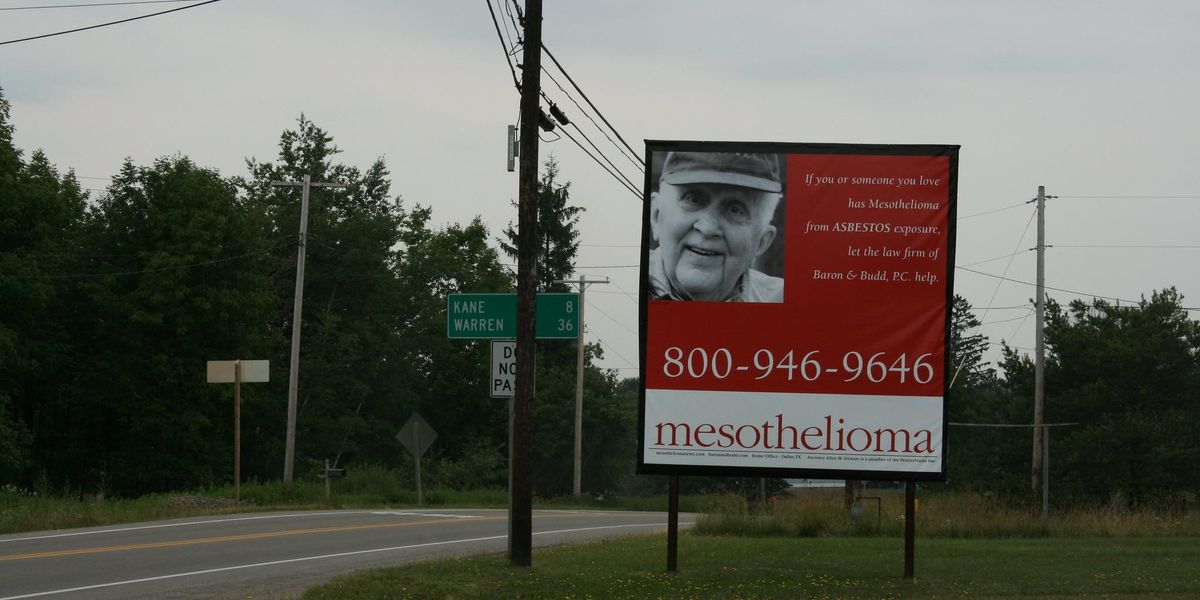
Mesothelioma: At an estimated 3,000 new U.S. cases per year, the disease may actually have fewer actual cases than it has those ubiquitous TV ads about it. For years, viewers have heard a mournful voice pushing the free info at www.mesobook.com on this asbestos-related ailment. While the law firm Maune Raichle Hartley French & Mudd distributes the book and promises that meso cases are “all we do,” quite a few other big firms take meso clients as well.
Talc: The link of talc – a.k.a. good ol’ baby powder — to asbestos-related diseases has spawned its own frenzy of whiplash-lawyer ads.
Camp LeJeune: The sprawling North Carolina Marine training base fed contaminated water to its troops, support staff and neighbors for more than 30 years. When President Biden signed a bill offering more than $2 billion in settlement funds for victims in August, trial lawyers went on an advertising rampage, reportedly buying at least $45 million in local and late night TV time to pitch their services for contamination cases
Oil: But the real money may be in not how much harm exists in lawyers touting the risks in some pesticide and cosmetics products, but in petrochemical makers telling us that they’re really good citizens after all. The trade group American Petroleum Institute and Big Oil firms shower news and public affairs shows with ads about their clean energy efforts. Drexel University Professor Emeritus Bob Brulle has estimated that the transfer of money from Big Oil to Big Broadcast is “in the billions” over the years.
This month the airwaves are extra-rotten with cash from both political parties. Few of these ads discuss broad visions or aspirations. They overwhelmingly focus on opponents’ moral failings, leaving viewers to conclude that both major parties are hopelessly corrupt. And while there may be a large element of truth to this, it doesn’t leave many of us hopeful that we’re up to tackling climate change any time soon.
And those ads reporting staggering winnings for a few victims of mesothelioma or glyphosate? Those funds are often diverted to pay trial expenses and attorney fees of 40% or more of the judgement.
And who walks away clean from all of this? The broadcasters and web operators who sell the airtime and webspace for those billions of dollars.
Peter Dykstra is our weekend editor and columnist and can be reached at pdykstra@ehn.org or @pdykstra.
His views do not necessarily represent those of Environmental Health News, The Daily Climate, or publisher Environmental Health Sciences.
Environmental rules, regardless of the president, are frequently challenged in court.
Lower federal courts, where thousands of decisions are made, often have the final say.
Recent judicial appointments have emphasized partisan alignment over experience, affecting court decisions on environmental issues.
Key quote:
“I do think we need a Supreme Court, appellate courts, trial courts, that respect the law and respect facts and avoid this kind of activist bent.”
— DJ Gerken, president of the Southern Environmental Law Center
Why this matters:
Judges' rulings shape the effectiveness of environmental regulations, impacting the government's ability to address critical climate issues. Increased judicial skepticism can undermine efforts to manage emerging environmental challenges.
CAMERON PARISH, La. — Late into the night, John Allaire watches the facility next to his home shoot 300-foot flares from stacks.
He lives within eyesight of southwest Louisiana’s salty shores, where, for decades, he’s witnessed nearly 200 feet of land between it and his property line disappear into the sea. Two-thirds of the land was rebuilt to aid the oil and gas industry’s LNG expansion. LNG — shorthand for liquified natural gas – is natural gas that's cooled to liquid form for easier storage or transport; it equates to 1/600th the volume of natural gas in a gaseous state. It’s used to generate electricity, or fuel stove tops and home heaters, and in industrial processes like manufacturing fertilizer.
In the U.S., at least 30 new LNG terminal facilities have been constructed or proposed since 2016, according to the
Oil and Gas Watch project. Louisiana and Texas’ Gulf Coast, where five facilities are already operating, will host roughly two-thirds of the new LNG terminals – meaning at least 22 Gulf Coast LNG facilities are currently under construction, were recently approved to break ground or are under further regulatory review.
Although the U.S. didn’t ship LNG until 2016, when a freight tanker left, a few miles from where Cameron Parish’s LNG plants are today, last year the country became the global leader in LNG production and export volume, leapfrogging exporters like Qatar and Australia. The
EIA’s most recent annual outlook estimated that between the current year and 2050, U.S. LNG exports will increase by 152%.
Allaire, 68, watches how saltwater collects where rainwater once fed the area’s diminishing coastal wetlands. “We still come down here with the kids and set out the fishing rods. It's not as nice as it used to be,” he told
Environmental Health News (EHN).
That intimacy with nature drew Allaire to the area when he purchased 311 acres in 1998. An environmental engineer and 30-year oil and gas industry veteran, he helped lead environmental assessments and manage clean-ups, and although retired, he still works part-time as an environmental consultant with major petroleum companies. With a lifetime of oil and gas industry expertise, he’s watched the industry's footprint spread across Louisiana and the Gulf of Mexico’s fragile shores and beyond. Now that the footprints are at the edge of his backyard, Allaire is among a cohort of organizers, residents and fisher-folk in the region mobilizing to stop LNG facility construction. For him, the industry’s expansion usurps the right-or-wrong ethics he carried across his consulting career. For anglers, oil and gas infrastructure has destroyed fishing grounds and prevented smaller vessels from accessing the seafood-rich waters of the Calcasieu River.
From the view of Allaire’s white pickup truck as he drives across his property to the ocean’s shore, he points to where a new LNG facility will replace marshlands. Commonwealth LNG intends to clear the land of trees and then backfill the remaining low-lying field.
“You see what’s happening with the environment,” Allaire said. “When the facts change, I got to change my mind about what we’re doing.”
Community bands together
John Allaire, left, purchased 311 acres in Cameron Parish in 1998, and has watched the oil and gas industry's footprint spread to his property.
Credit: John Allaire
During an Earth Day rally in April, community members gathered in the urban center of Lake Charles to demand local oil and gas industries help deliver a safer, healthier future for all. In between live acts by artists performing south Louisiana’s quintessential zydeco musical style, speakers like James Hiatt, a Calcasieu Parish native with ties to Cameron Parish and a Healthy Gulf organizer, and RISE St. James organizer Sharon Lavigne, who’s fighting against LNG development in rural Plaquemines Parish near the city of New Orleans, asked the nearly 100 in attendance to imagine a day in which the skyline isn’t dotted by oil and gas infrastructure.
Not long ago, it was hard to imagine an Earth Day rally in southwest Louisiana at all. For decades, the area has been decorated with fossil fuel infrastructure. Sunsets on some days are highlighted by the chemicals in the air; at night, thousands of facilities’ lights dot the dark sky.
“It takes a lot of balls for people to start speaking up,” Shreyas Vasudevan, a campaign researcher with the Louisiana Bucket Brigade, told EHN in the days after the rally. In a region with its history and economy intertwined with oil and gas production, “you can get a lot of social criticism – or ostracization, as well – even threats to your life.”
Many are involved in local, regional and national advocacy groups, including the Louisiana Bucket Brigade, Healthy Gulf, the Sierra Club, the Natural Resources Defense Council, the Turtle Island Restoration Network, the Center for Biological Diversity and the National Audubon Society.
“You see what’s happening with the environment,” Allaire said. “When the facts change, I got to change my mind about what we’re doing.” - John Allaire, environmental engineer and 30-year oil and gas industry veteran
But environmental organizers are fighting a multi-billion-dollar industry with federal and state winds at its back. And LNG’s federal support is coupled with existing state initiatives.
Under outgoing Louisiana Gov. John Bel Edwards — a term-limited Democrat — the state pledged a goal of reaching net-zero greenhouse emissions by 2050. Natural gas, which the LNG industry markets as a cleaner-burning alternative, is cited as one of the state’s solutions. Louisiana is the only state that produces a majority of its carbon emissions through fossil fuels refining industries, like LNG, rather than energy production or transportation. Governor Edwards’ office did not return EHN’s request for comment.
This accommodating attitude towards oil and gas industries has resulted in a workforce that’s trained to work in LNG refining facilities across much of the rural Gulf region, said Steven Miles, a lawyer at Baker Botts LLP and a fellow at the Baker Institute’s Center on Energy Studies. Simultaneously, anti-industrialization pushback is lacking. It’s good news for industries like LNG.
“The bad news,” Miles added. “[LNG facilities] are all being jammed in the same areas.”
One rallying cry for opponents is local health. The Environmental Integrity Project found that LNG export terminals emit chemicals like carbon monoxide –potentially deadly– and sulfur dioxide, of which the American Lung Association says long-term exposure can lead to heart disease, cancer, and damage to internal or female reproductive organs.
An analysis of emissions monitoring reports by the advocacy group the Louisiana Bucket Brigade found that Venture Global’s existing Calcasieu Pass facility had more than 2,000 permit violations.That includes exceeding the permit’s authorized air emissions limit to release nitrogen oxides, carbon monoxide, particulate matter and volatile organic compounds 286 out of its first 343 days of operation.
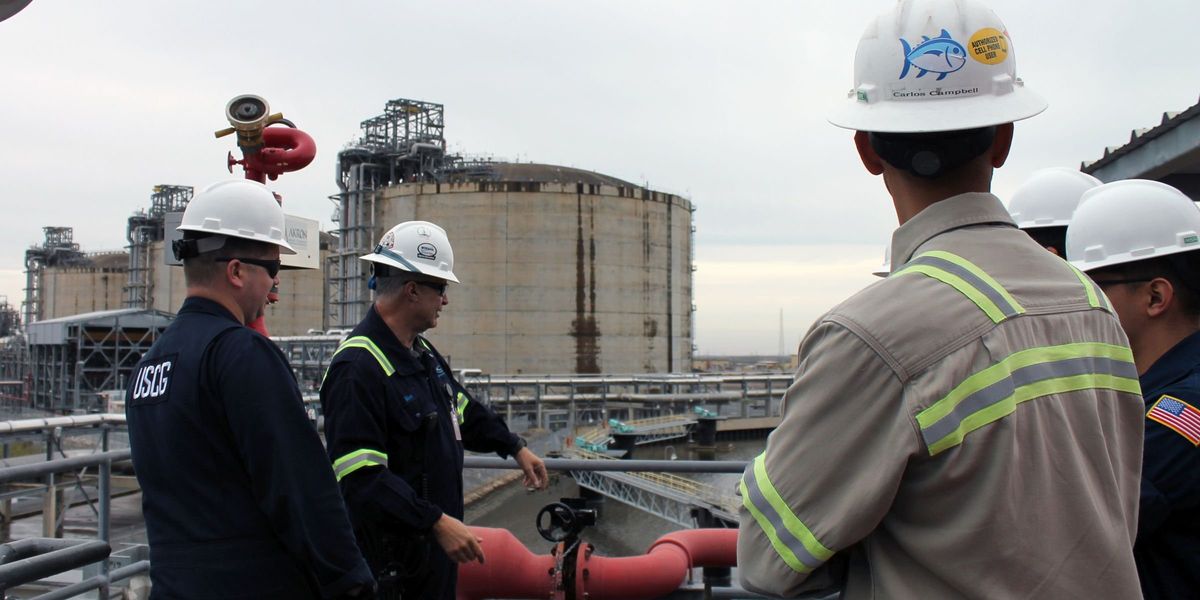
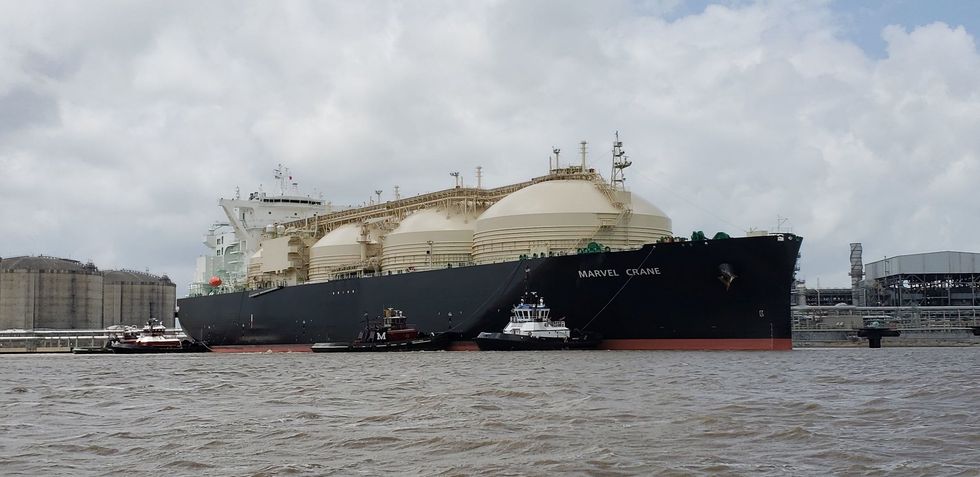
The Marvel Crane, the first liquid natural gas carrier to transport natural gas from the Southwest Louisiana LNG facility, transits a channel in Hackberry, Louisiana, May 28, 2019.
“This is just one facility,” at a time when three more facilities have been proposed in the region and state, Vasudevan said. Venture Global’s operational LNG facility — also known as Calcasieu Pass — “is much smaller than the other facility they’ve proposed.”
In an area that experienced 18 feet of storm surge during Hurricane Laura in 2020 — and just weeks later, struck by Hurricane Delta — Venture Global is planning to build a second export terminal Known as “CP2,” it’s the largest of the roughly two dozen proposed Gulf LNG export terminals, and a key focal point for the region’s local organizing effort.
Residents “don’t really want LNG as much as they want Cameron [Parish] from 1990 back,” Hiatt told EHN of locals’ nostalgia for a community before storms like Rita in 2005 brought up to 15 feet of storm surge, only for Laura to repeat the damage in 2020. Throughout that time, the parish’s population dipped from roughly 10,000 to 5,000. “But the wolf knocking at the door is LNG. Folks in Cameron think that's going to bring back community, bring back the schools, bring back this time before we had all these storms — when Cameron was pretty prosperous.”
“Clearly,” for the oil and gas industry, “the idea is to transform what was once the center of commercial fishing in Louisiana to gas exports,” Cindy Robertson, an environmental activist in southwest Louisiana, told EHN.
Helping fishers’ impacted by LNG is about “actual survival of this unique culture,” Cooke said.
In a measure of organizers’ success, she pointed to a recent permit hearing for Venture Global’s CP2 proposal. Regionally, it’s the only project that’s received an environmental permit, but not its export permit, which remains under federal review. At the meeting, some spoke on the company’s behalf. As an organizer, it was a moment of clarity, Cooke explained. Venture Global officials “had obviously done a lot of coaching and organizing and getting people together in Cameron to speak out on their behalf,” Cooke said. “So, in a way, that was bad. But in another way, it shows that we really had an impact.”
“It also shows that we have a lot to do,” Cooke added.
Environmental organizers like Alyssa Portaro describe a sense of fortitude among activists — she and her husband to the region’s nearby town of Vinton near the Texas-Louisiana border. Since the families’ relocation to their farm, Portaro has worked with Cameron Parish fisher-folk.
“I’ve not witnessed ‘community’ anywhere like there is in Louisiana,” Portaro told EHN. But a New Jersey native, she understands the toll environmental pollution has on low-income communities. “This environment, it’s so at risk — and it’s currently getting sacrificed to big industries.”
“People don’t know what we’d do without oil and gas. It comes at a big price,” she added.
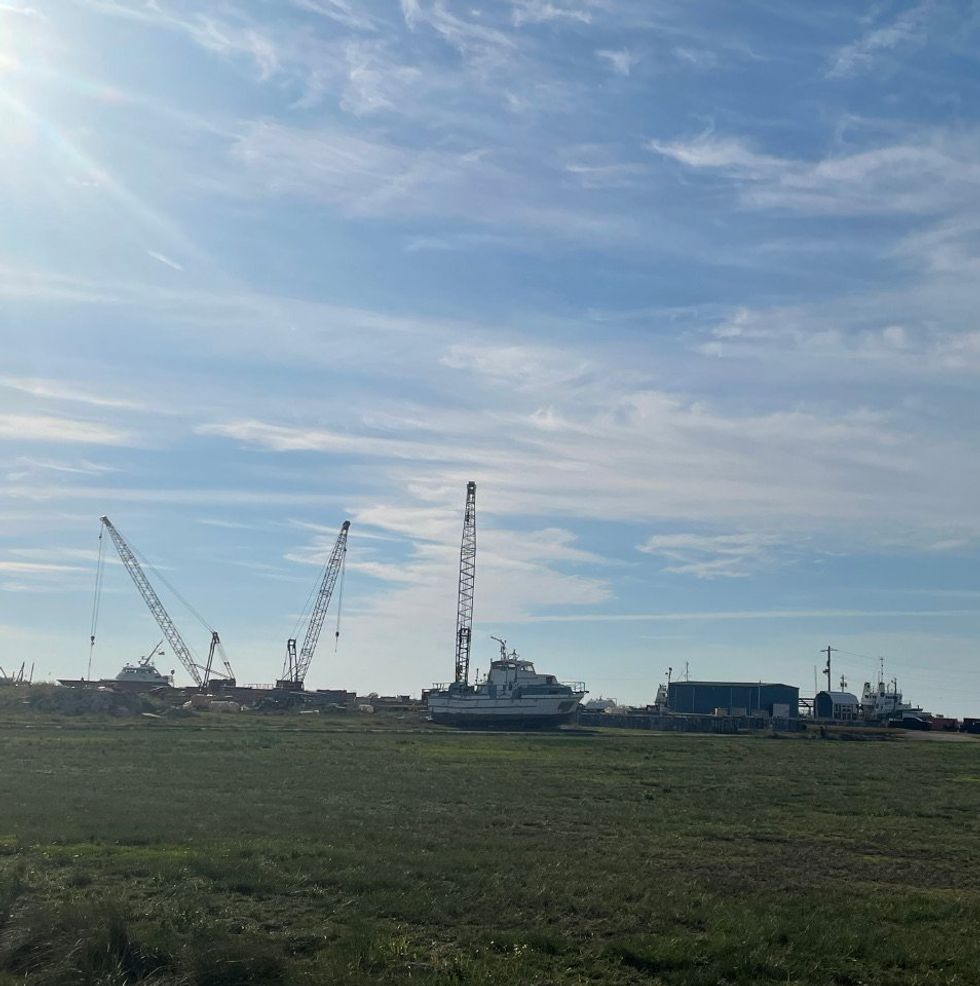
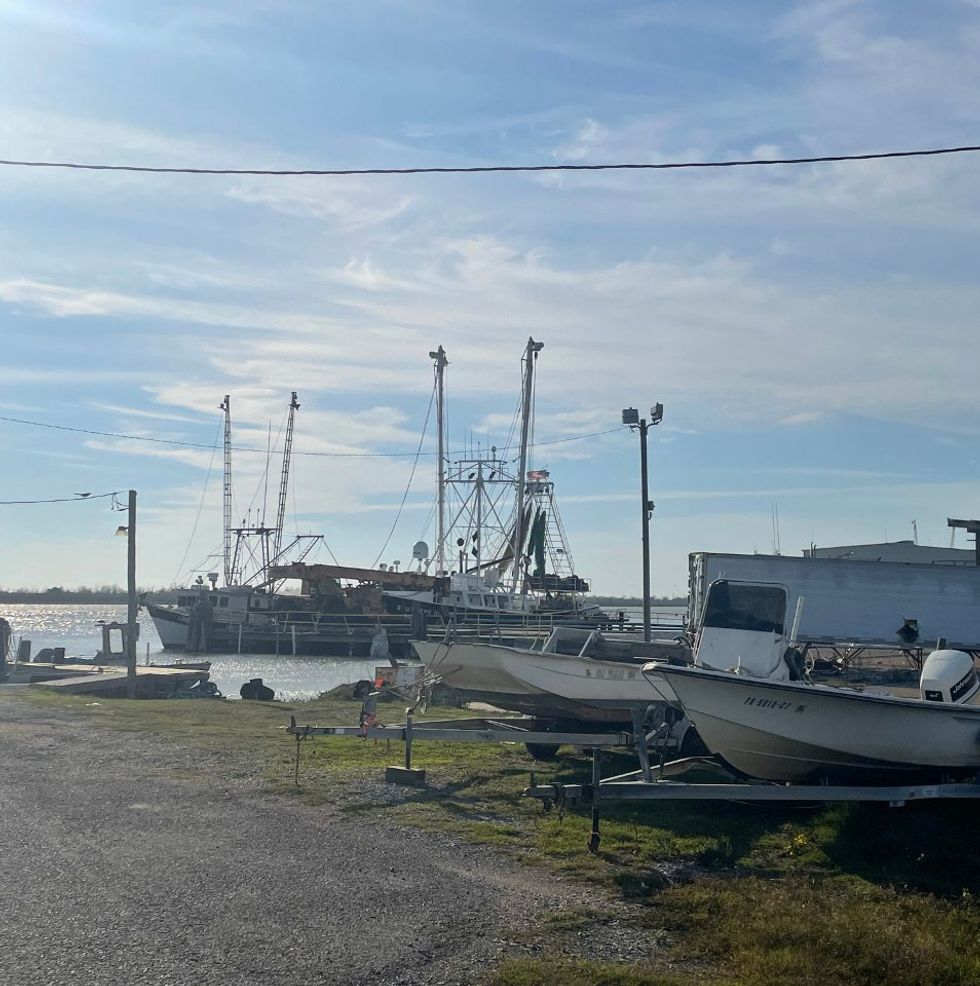
Southwest Louisiana’s Cameron Parish is one of the state’s most rural localities. Marine economies were the area’s economic drivers until natural disasters and LNG facilities began pushing locals out, commercial fishers claim.
Credit: Xander Peters for Environmental Health News
Residents “don’t really want LNG as much as they want Cameron [Parish] from 1990 back,” James Hiatt , a Healthy Gulf organizer, told EHN. "But the wolf knocking at the door is LNG."
Credit: Xander Peters for Environmental Health News
For the most part, Cameron Parish’s life and economy has historically taken place at sea. As new LNG facilities are operational or in planning locally, locals claim the community they once knew is nearly unrecognizable.
Credit: Xander Peters for Environmental Health News
A disappearing parish
The stakes are seemingly higher for a region like southwest Louisiana, which is the epicenter of climate change impacts.
In nearly a century, the state has lost roughly 2,000 square miles of land to coastal erosion. In part driving the state’s erosion crisis is the compounding impacts of Mississippi River infrastructure and oil and gas industry activity, such as dredging canals for shipping purposes, according to a March study published in the journal Nature Sustainability. Louisiana’s Coastal Protection and Restoration Authority said Cameron Parish could lose more land than other coastal parishes over the next 50 years. A recent Climate Central report says the parish will be underwater within that time frame.
On top of erosion and sea level rise impacts, in August, 2023, marshland across southwest Louisiana’s Cameron Parish burned. The fires were among at least 600 across the Bayou State this year. Statewide, roughly 60,000 acres burned — a more than six-fold increase of the state’s average acres burned per year in the past decade alone.
But while the blaze avoided coastal Louisiana communities like Cameron Parish, the fires represented a warning coming from a growing chorus of locals across the region — one that’s echoes by the local commercial fishing population, who claimed to have experienced unusually low yields during the same time, according to a statement from a local environmental group. At the site of the Cameron Parish fires are locations for two proposed LNG expansion projects.
"The idea is to transform what was once the center of commercial fishing in Louisiana to gas exports.” - Cindy Robertson, an environmental activist in southwest Louisiana
It was an unusual occurrence for an area that’s more often itself underwater this time of year due to a storm surge from powerful storms. For LNG expansion’s local opposition, it was a red flag.
As the Louisiana Bucket Brigade has noted prior, the confluence of climate change’s raising of sea levels and the construction of LNG export terminals — some are proposed at the size of nearly 700 football fields — are wiping away the marshland folks like Allaire watched wither. Among their fears is that the future facilities won’t be able to withstand the power of another storm like Laura and its storm surge, which wiped away entire communities in 2020.
Amidst these regional climate impacts, LNG infrastructure has shown potential to exacerbate the accumulation of greenhouse gasses that cause global warming. For the most part, LNG is made up of methane — a greenhouse gas that’s more than 80 times more potent than carbon dioxide in the atmosphere. Among the 22 current LNG facility proposals, the advocacy group Sierra Club described a combined climate pollution output that would roughly equal to that of about 440 coal plants.
The climate impacts prompt some of the LNG industry’s uncertainty going forward. It isn’t clear if Asian countries, key importers of U.S. LNG, will “embrace these energy transition issues,” said David Dismuke, an energy consultant and the former executive director of Louisiana State University’s Center for Energy Studies. Likewise, European nations remain skeptical of embracing LNG as a future staple fuel source.
“They really don't want to have to pull the trigger,” Dismukes added, referring to Europe’s hesitation to commit more resources to exporting LNG from the American market. “They don't want to go down that road.”
While there will be a tapering down of natural gas supply, Miles explained, “we’re going to need natural gas for a long time,” as larger battery storage for renewables is still unavailable.
“I'm not one of these futurists that can tell you where we're going to be, but I just don't see everything being extreme,” Dismukes said. “I don't see what we've already built getting stranded and going away, either.”
For now, LNG seems here to stay. From 2012 to 2022,U.S. natural gas demand — the sum of both domestic consumption and gross exports — rose by a whopping 43%, reported the U.S. Energy Information Administration, or EIA. Meanwhile, in oil and gas hotbeds like Louisiana and Texas, natural gas demand grew by 116%.
Throughout 25 years, Allaire has witnessed southwest Louisiana’s land slowly fade, in part driven by the same industrial spread regionally. Near where the front door of his travel trailer sits underneath the aluminum awning, he points to a chenier ridge located near the end of the property. It’s disappearing, he said.
“See the sand washing over, in here?” Allaire says, as he points towards the stretches of his property. “This pond used to go down for a half mile. This is all that's left of it on this side.”
Hurricane Beryl, a Category 1 storm, caused extensive damage in Houston, including fallen trees, flooded streets, and power outages.
The storm killed at least three people and left 2.7 million Texas homes without power.
Residents are now assessing damage, cleaning up, and waiting for power to return.
Key quote:
“The rebuild is going to be significant. There was real damage. But the good news is for Houston, this ain’t our first rodeo.”
— Ted Cruz, U.S. Senator
Why this matters:
Houston, known for its booming energy sector and diverse population, has become a focal point for studying the impacts of severe weather. The city's low-lying geography and proximity to the Gulf of Mexico make it particularly susceptible to hurricanes and heavy rainfall. In recent years, storms like Hurricane Harvey have wreaked havoc, leaving thousands homeless and causing billions in damages.
Earth's average temperature stayed above 1.5°C for 12 consecutive months, the first such occurrence in recorded history.
Scientists stress that this 12-month period does not mean the Paris Agreement's 1.5°C limit has been breached, as that target is based on longer-term averages.
Climate experts warn that, without significant reductions in greenhouse gas emissions, more temperature records will be broken, and long-term warming trends will continue.
Key quote:
"This is more than a statistical oddity and it highlights a large and continuing shift in our climate."
— Carlo Buontempo, director of Copernicus Climate Change Service.
Why this matters:
This sustained warmth has far-reaching consequences. Extreme weather events such as hurricanes, heatwaves and wildfires are becoming more frequent and intense, wreaking havoc on communities and ecosystems. Rising temperatures also accelerate the melting of polar ice, contributing to sea-level rise that threatens coastal cities and island nations.
Jim Inhofe, a long-serving senator from Oklahoma, died at 89 after a stroke. He was known for his fierce opposition to climate change science.
Inhofe held significant influence over environmental policy, chairing the Senate Environment and Public Works Committee.
He was a key figure in appointing Trump-era EPA administrators and worked to roll back Obama-era environmental regulations.
Key quote:
“Jim is a climate change denier. He is really, really conservative, but you know what, he is a decent guy and I like him, and he and I are friends.”
— Senator Bernie Sanders, (D) Vermont
Why this matters:
Jim Inhofe's passing marks the end of an era in American politics, but the debates he fueled will undoubtedly persist as the nation and the world strive to address one of the most pressing issues of our time. Read more in Peter Dykstra's essay: Happy birthday, Senator Inhofe!
The Ahousaht and Tla-o-qui-aht First Nations will now oversee the conservation of 760 square kilometers of old-growth forests in Clayoquot Sound, with the support of philanthropic funding.
The B.C. government and First Nations have designated 760 square kilometers of old-growth forests as protected conservancies.
These protections nearly double the amount of safeguarded old growth in Clayoquot Sound to 1,639 square kilometers.
Nature United provided $40 million to help First Nations buy out forestry-tenure holders, enabling this conservation effort.
Key quote:
"Collaborative work with First Nations is a cornerstone of our vision for old growth in this province."
— Bruce Ralston, B.C. minister of forests
Why this matters:
Protecting old-growth forests is important for maintaining ecosystem health, carbon storage, and cultural practices. By preserving these forests, we’re not only safeguarding the planet but also ensuring cleaner air and water for the surrounding communities. Read more: The push for standing forest protections in US climate policy.
Companies like Land O’Lakes and Bayer are integrating pesticide sales with carbon market platforms, potentially increasing chemical use.
Agricultural carbon markets, originally designed to offset greenhouse gases, now often incentivize practices requiring pesticides.
Environmental groups worry these markets prioritize sales over genuinely reducing farm chemical dependence.
Key quote:
“Get a farmer in the program, get the information, and get to sell them seeds or pest control.”
— Ben Lilliston, director of rural strategies and climate change, Institute for Agriculture and Trade Policy
Why this matters:
Pesticides, essential for controlling pests and ensuring crop yields, have a dark side. Their overuse can lead to a host of environmental issues, including soil degradation, water contamination, and loss of biodiversity. In addition, the production and application of these chemicals contribute to greenhouse gas emissions, potentially offsetting the reductions achieved through carbon markets.
As mounds of dredged material from the Houston Ship Channel dot their neighborhoods, residents are left without answers as to what dangers could be lurking.