I'm not terribly disappointed that, by moving from Washington D.C. to Georgia, I've missed the last two Brood X cicada invasions.
Let's get a few things straight: The "X" in "Brood X" is a Roman number, so just say "Brood Ten." But that means calling the noisy ones "X-Men" doesn't work (ATTN: TV Newsreaders). And they don't dig out from their 17-year hiatus until the ground temperature reaches 64°F (17.8°C). The best concise description of Brood X/Ten I found is at this page from the National Park Service.
And a final dirty human secret about the Brood Ten cicadas: Their range only covers portions of a few mid-Atlantic states and D.C. But that means they're enabled to disrupt every outdoors live shot from every TV reporter in Washington D.C.
The clinchers came on Wednesday, when President Biden battled off a cicada on his departure to Europe, some of the six-legged assailant's hench-insects delayed the White House press corps plane by six hours when they lodged themselves in an auxiliary engine.
Which affirms a dirty not-so-secret about what many consider an East Coast media bias: What happens in Washington or New York speaks for the entire country.
In this case, the speaking was done by the wings of countless male cicadas, looking to get back in the breeding game after 17 years literally underground. The cicadas should be quiet by the end of the month, to return in 2038. The resident population of alleged East Coast media bias will probably be waiting for them.
Asian carp
So enough about insects and journalists. Fish and journalists, anyone?
If you think TV folks love cicada stories, try Asian carp. The fish were brought to the U.S. in the mid-20th century to control algae blooms near sewage treatment plants and fish farms. One species, the silver carp, made its way from Mississippi Delta catfish farms upriver to Illinois, outcompeting native fish all the way.
But these fish have a quirky defensive behavior that's also fabulous slapstick comedy. When threatened or alarmed, silver carp can breach up to 15 feet in the air. I've watched video of fishermen rejoicing as fish fulfill an old myth by literally jumping into the boat; a wildlife biologist hit full in the trousers by an airborne carp; or a TV reporter striking theatrical paydirt when hit upside the head with a frightened fish.
Noodling for catfish
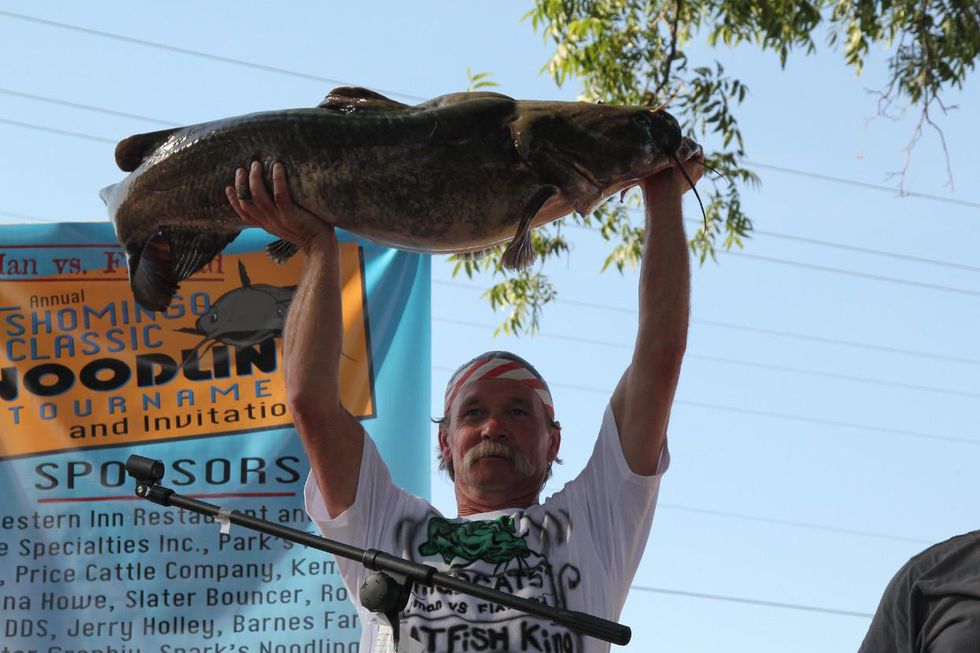
Noodling fishing tournament in Oklahoma. (Credit: Nate/flickr)
And finally, I can't leave the topic of human-wildlife interaction without giving a shout-out to the sport of noodling—also known as handgrabbing.
The last time I checked, noodling was legal (sometimes with restrictions) in 11 states. It involves the catching of catfish by unconventional means: allowing an enormous flathead or channel catfish to mistake your arm for a meal, then running a rope through the channel cat's mouth and gills. Or, for expediency and on smaller (maybe 20 lbs.) cats, ditch the rope and just run your hand through the mouth and out the gills.
Either way, hobbying hazards from having a giant fish try to swallow your arm can include infections, broken bones, injured muscles and tendons and scar tissue up to the elbow. Whooppeee!
This 13-minute video from father-daughter YouTube noodling sensations Jeff and Hannah Barron will change your life.
Or not.
Peter Dykstra is our weekend editor and columnist and can be reached at pdykstra@ehn.org or @pdykstra.
His views do not necessarily represent those of Environmental Health News, The Daily Climate, or publisher, Environmental Health Sciences.
Banner photo credit: MostlyDross/flickr